Film reviews and more since 2009
Publication Date: 12-08-2025
Die Hard (1988) review
Dir. John McTiernan
By: Steve Pulaski
Rating: ★★★½
John McTiernan’s Die Hard, like most great films, was probably never conceived to reinvent the wheel of its genre. I’m sure by the time shooting wrapped and post-production commenced, almost everyone involved was at the very least confident in the project they had invested time and money into. The $28 million flick then debuted in the middle of a hot summer in 1988 to strong reviews that only became more appreciative of its style and more generous in their praise of a taut and bold motion picture. The rest is history in the most rose-colored sense of the word.
One of the reasons Die Hard continues to make waves as one of the finest action films ever cut and released is due in part to how uniform it is in a quality-control sense. Few action movies even in the past could so laudably pull off what McTiernan and company accomplish in this unassuming feature. The answer lies in efficiency.
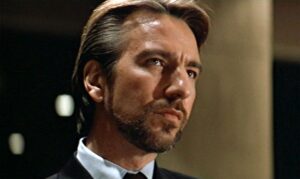
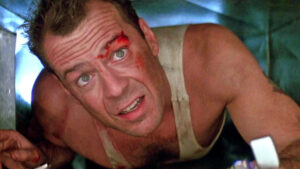
Let’s start with the obvious: the screenplay by Jeb Stuart (The Fugitive) and Steven E. de Souza (Judge Dredd) is lean and mean. Mercilessly effective in inspiring suspense while still taking the time to set the scene and the stakes, Stuart and de Souza demonstrate efficiency in the strongest sense of the word when laying the groundwork for this actioneer. They understand that audiences need to be given souls and situations to care about in equal measures. Even if Bruce Willis’ streetwise, New York cop John McClane is a little too lucky at times, and superhuman at others, it’s his down-to-earth qualities that make him so relatable, so blue-collar. Consider when he gets to the roof of the Nakatomi tower upon learning its been hijacked by twelve terrorists led by a German ringleader named Hans Gruber (Alan Rickman). He commits the no-no of swearing on an FCC-monitored frequency, and when met with intense skepticism from dispatchers, who inform him that the frequency in-use is only for emergency phone-calls only, he responds with, “no fuckin’ shit, lady, does it sound like I’m ordering a pizza?” Like a president making a March Madness bracket, or a CEO trying on the gear of his assembly line workers, you just can’t get more empathy than that.
Adding on, Rickman’s villain is on-par with his plan; both are buoyed by enough details to make you care about them. We understand not only the motivations of Gruber but also his process by the time the first act of the film concludes, and we recognize his desire to use police protocol during potential hostage situations in his favor. A cheaper action script might have the villain lazily using C-4 explosives to blast through a bank vault. Stuart and de Souza decide to take a more clever route, setting up the vault doors to be controlled by electromagnets that become disabled at the loss of power. It’s one thing to suggest this, it’s another to fearlessly and thoughtfully implement it in the script. The duo manage to pull off both; it’s a little narrative point that gives the film that much more weight.
McTiernan is also very aware of his presentation and the labyrinth-like qualities that enormous skyscrapers possess. His work is liberating enough for cinematographer Jan de Bont (who would later go on to McTiernan’s The Hunt for Red October and Paul Verhoeven’s Basic Instinct) to make it visually clear and editors Frank J. Urioste and John F. Link to capture the Nakatomi building (the real-life Fox Plaza in Los Angeles) in a way that allows for a linear presentation. A premise like this is ripe for being discombobulating, capable of pulling the viewer into too many directions and fogging up their sense of placement within the story. Thanks to the capable editing hands of Urioste and Link, instead of being disorienting, Die Hard is great to look at and oft-exhilarating thanks to the dimension afforded to the large-scale sets and sequences.
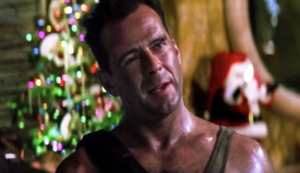
But this is very much McTiernan’s coaster to craft, and he does it in the way he knows best. High octane chases, explosive moments, and canted angles all get stirred into a melting pot of footage tailored to earn the acclaim it deserves. There are many memorable moments in Die Hard. Take the scene when Sgt. Al Powell (Reginald VelJohnson in a role that could’ve been disruptive and manic but is instead the equivalent of a cherry atop a sundae) learns of the danger unfolding inside the Nakatomi building, and proceeds to reverse his police car backwards at whiplash-inducing speeds before rendering himself immobile. Or recall when McClane pitches a collection of live explosives down an elevator shaft from 30+ stories in the air, not realizing that backdraft has to go somewhere. Even comparatively smaller scenes such as when Gruber tries to pull a fast one on McClane by convincing him he’s one of the hostages shows McTiernan’s ability to conjure up tension by the very ambiance of a given scene. Regardless of the size of the scene, McTiernan is impressive, and his skills and camerawork rise to the occasion every time.
I could go on, but you get the idea. Die Hard‘s legacy is so strong for a number of reasons, but I’d like to think the reason it’s so indestructible is due to the fact that its aesthetics are so strong and its filmmaking is so formidable. Even if you can’t process it in a technical sense or explain it using the appropriate jargon, you can feel its effect on your mood and your senses. It stimulates the mind and engages just like a good action (or Christmas) movie should.
My review of Die Hard 2
My review of Die Hard with a Vengeance
My review of Live Free or Die Hard
My review of A Good Day to Die Hard
Starring: Bruce Willis, Alan Rickman, Bonnie Bedelia, Alexander Godunov, Reginald VelJohnson, Paul Gleason, and De’voreaux White. Directed by: John McTiernan.

About Steve Pulaski
Steve Pulaski has been reviewing movies since 2009 for a barrage of different outlets. He graduated North Central College in 2018 and currently works as an on-air radio personality. He also hosts a weekly movie podcast called "Sleepless with Steve," dedicated to film and the film industry, on his YouTube channel. In addition to writing, he's a die-hard Chicago Bears fan and has two cats, appropriately named Siskel and Ebert!