
Film reviews and more since 2009
Publication Date: 01-12-2026
Dead Alive (1992) review
Dir. Peter Jackson
By: Steve Pulaski
Rating: ★★★½
NOTE: Peter Jackson’s Dead Alive is referred to as “Braindead” outside of North America. I’m choosing to review it as “Dead Alive” for no other reason other than that was how the film was introduced to me when I was a teenager.
Greg Kihn could’ve just as easily been talking about the bygone genre of the splatter film when he wrote his hit “The Breakup Song” in 1981. Peter Jackson’s Dead Alive is such a brilliant staple of gratuitously gory horror that it’s only more surprising the film came out in 1992, a good five years after the splatter film and slasher epidemic had run their courses in American cinema. Dario Argento’s blood-soaked operas and MGM’s cookie-cutter horror formula had proven to be a lit less than lucrative in the coming years, as predictability bred indifference amongst an audience that had seen every spatter of gore and every bloodcurdling scream they could before they waived their stained white flag in defeat. Then along comes Jackson’s nasty little film, part homage, part genre-exercise, and maybe even part satire, of the splatter film to show that the craft was far from dead, or brain-dead for that matter.
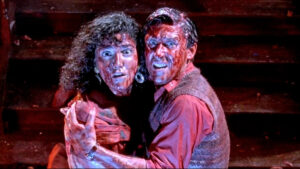
The setup: in the late fifties, an explorer set out to scout Skull Island in search of a Sumatran Rat-Monkey, a hideous creature spawned from diseased rats breeding with tree monkeys. While the explorer never returned alive after being bitten by the Rat-Monkey, the Rat-Monkey made its way to a zoo in New Zealand, eventually biting Vera (Elizabeth Moody), the elderly mother of middle-aged Lionel (Timothy Balme). Soon after being bitten, Vera begins to be consumed by a violent, flesh-eating sickness that has her coughing up blood and mucus and eventually attacking Lionel and his new Spanish girlfriend, Paquita (Diana Peñalver). When Vera (presumably) dies, Lionel uses a tranquilizer on her to assure she keeps still, but when a gang of thugs vandalize her grave, Vera rises from the dead and helps create a new breed of hungry zombies that terrorize the town.
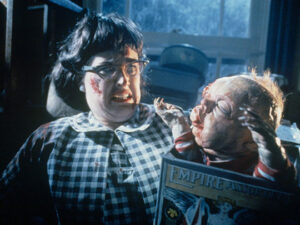
The result: a disgusting but enthusiastic celebration of all things practical and gory. Co-writer/director Peter Jackson — who wrote the film along with Stephen Sinclair and Fran Walsh — embrace realistic special effects, undoubtedly going through the added trouble but great reward of using gizzards, meats, impeccable costumes, and several gallons of fake blood to create something that has the ability to frighten and gross-out. If you get sick at any time during Dead Alive, you’ve likely prompted the reaction for which Jackson and company were crossing their fingers. Desperately few horror films have this much fun being this disgusting and far fewer employ a crew that is so eager to throw meats and makeshift orifices at the screen just to see what sticks.
The impact: more than a handful of memorable moments housed within a romp that ostensibly doesn’t know how not to be so gross. A personal favorite comes when Lionel tries to conceal the presence of an utterly repulsive-looking zombie infant by way of a baby-carriage. The infantile zombie winds up seizing control of the carriage before a park-full of tykes and goes on an adventure of his own as Lionel breathlessly chases after him, or it. Another comes during the climactic bloodbath that has Lionel and Paquita together, using the base of a lawnmower to sever and behead numerous zombies all at once as they attempt to overtake a large home.
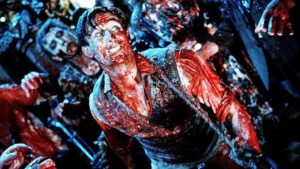
Climaxes like Dead Alive inspire a rare sense of satisfaction one gets if they’ve ever played a video game and were tasked to kill an onslaught of enemies that made a courageous attempt to swarm the playable character all at once. As Lionel and Paquita fight off hordes of zombies, Jackson keeps spatial awareness in mind, always filling each cut with something interesting to look at and keeping our protagonists within arm’s length, so to speak. Moments within moments, such as Lionel struggling to find footing from the copious amount of blood spilled on the floor, or Paquita combating an accent in effort to aid Lionel in fighting off his reincarnated mother, impress sometimes just as much as bigger, overarching spectacle. Some might even have greats like George A. Romero and Tom Savini quietly mumbling to themselves, “why didn’t I think of that?”
Dead Alive is a horror classic for good reason, one that was in itself resurrected from the often unforgiving death of obscurity once Jackson made a name for himself with the Lord of the Rings trilogy. It was then Jackson’s love for classic horror, the splatter films of yesteryear, and excess guts and gore became known and heralded almost as much as his adaptation of J.R.R. Tolkien’s timeless series. While people didn’t know it at the time, this post-release footnote about Dead Alive is interesting and meaningful given that, whether people knew it or not, authenticity and dedication to a craft were some of the reasons why this particular film succeeded so overwhelmingly with its core audience. I’d like to think one of the reasons Lord of the Rings was made — even if it was only a passing thought in the racing mind of Jackson, who has gone on to be an unforgettable name in the index of great Hollywood visionaries — was so people could return to his earlier filmography and see that he has stuck to his roots and has always been this dedicated to his work. He just has more money to make bigger things work now.
Starring: Timothy Balme, Elizabeth Moody, Diana Peñalver, and Ian Watkin. Directed by: Peter Jackson.

About Steve Pulaski
Steve Pulaski has been reviewing movies since 2009 for a barrage of different outlets. He graduated North Central College in 2018 and currently works as an on-air radio personality. He also hosts a weekly movie podcast called "Sleepless with Steve," dedicated to film and the film industry, on his YouTube channel. In addition to writing, he's a die-hard Chicago Bears fan and has two cats, appropriately named Siskel and Ebert!