
Film reviews and more since 2009
Publication Date: 04-06-2026
Jiro Dreams of Sushi (2011) review
Dir. David Gelb
By: Steve Pulaski
Rating: ★★★½
EDITOR’S NOTE: This review was written back in July 2012. I’m happy to reveal that, since then, I’ve not only tried sushi, but eat it on a regular basis.
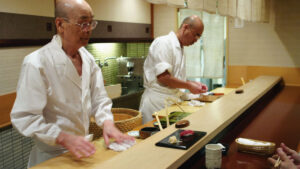
I have never eaten sushi in my life, but would throw all pending assumptions and thoughts out the window if I was offered sushi made by the great Jiro Ono, the main subject of the documentary, Jiro Dreams of Sushi. He tells us early on in the film that the key to success is immersing yourself in your work and what you do, and being a dedicated and sophisticated employee, never complaining or expressing disdain for your job.
Ono has been running a three-star (the highest rating) sushi shop in Tokyo for decades and never misses a beat. His shop is the go-to place for unmatchable sushi, luxurious decor, and elegant atmosphere, yet the month-in-advance reservations (probably have gone up to six month reservations after the release of this documentary) and the expensive dining may turn off customers in the area. This isn’t some place you could just decide to eat at one night for dinner on impulse for reasons other than the long wait. You must prepare yourself in stomach and spirit to eat here.
The film shows the man himself at 86-years-old, still rising at dawn everyday to go and work for his sushi establishment in a tireless fashion. He hates holidays the most, because that means he has to stay home and be bored. He left home at seven, has never reconnected with his parents, but has kept his sons close by for his entire life. His eldest, Yoshikazu, fifty, has been working beside him since he was nineteen years old. He hated it back then, but now sees the job as meaningful and honorary. One day, Jiro emphasizes, Yoshikazu will have to man the shop by himself, and that is a day he fears will come too soon.
While Yoshikazu is obviously skilled, it is noted that he is not the painstaking perfectionist that his father his. When Jiro rises at dawn, he goes into the shop and eyes every little detail, such as the arrangement of the plates, silverware, and even what hand the customers eat with so he knows where to place the sushi on their marble pallets. It is difficult to find a man so dedicated and intricate about his seemingly simple line of work, and one man in the documentary claims that even if Yoshikazu’s sushi doesn’t measure up to his fathers’ when he dies by the slightest thing, people will likely not return to the restaurant. And even if his sushi is twice as good, it will only be viewed as “just as good.”
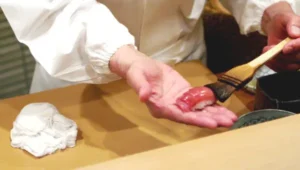
Jiro’s younger son, Takashi, runs a two-star restaurant in Tokyo for many years, but he boasts a more casual atmosphere for his customers, rather than the mature and stern one his father has created. Both Jiro and Takashi have one thing in common and that is they boast a rather minimalist slice of fish as their course, yet they meticulously pack so much flavor and craft into that little piece that the taste and impact is never forgotten. There is even a full segment in the film where Jiro explains the difference between fatty, medium, and lean tuna, explaining that while fatty tuna has a predictable taste to it, lean tuna boasts a more subtle concoction of elegance.
One questionable omission from the documentary is why we never hear or see Jiro’s wife. Assuming she’s even still alive, she must’ve had a grand opinion on her husband line of work and her sons who relentlessly try and model off of him. Unfortunately, her absence leaves somewhat of hole in an otherwise perfect film.
A food critic who makes many appearances at Jiro’s restaurant is quoted in saying there are five attributes that should make up every chef. They are consistency, the hunger for improvement, cleanliness, impatience, and are all tied together by unbreakable passion for their work. The critic explains how he believes that Jiro soars in all of these characteristics, stating that he has never seen a restaurant leader employ so much seriousness in his work, nor has he ever seen one so harsh and critical of it even after countless years of success.
Walking into Jiro Dreams of Sushi blind, much like seeing Bill Cunningham: New York, a documentary on The New York Times fashion photographer, I went in interested but questioning the purpose for profiling a character who does something so simple that there must be more to his personality, creativity, motivation, and charm, and sure enough, I was on the right track. Much like the people I found in Mark Wexler’s extraordinary documentary on centenarians, How To Live Forever, we see an aging man who is quicker and smarter than most of the people found on reality Television and is doing something of sheer simplicity and meaning, yet he can not get broader, more mainstream recognition. Jiro Dreams of Sushi is the reason why documentaries are and should be made, and that reason is to showcase talents, uniqueness, and memorable quirks that would otherwise go tragically unnoticed in a society dominated by “the next big laugh.”
Starring: Jiro Ono, Yoshikazi Ono, and Takashi Ono. Directed by: David Gelb.

About Steve Pulaski
Steve Pulaski has been reviewing movies since 2009 for a barrage of different outlets. He graduated North Central College in 2018 and currently works as an on-air radio personality. He also hosts a weekly movie podcast called "Sleepless with Steve," dedicated to film and the film industry, on his YouTube channel. In addition to writing, he's a die-hard Chicago Bears fan and has two cats, appropriately named Siskel and Ebert!