
Film reviews and more since 2009
Publication Date: 08-02-2026
Pirates of the Caribbean: The Curse of the Black Pearl (2003) review
Dir. Gore Verbinski

By: Steve Pulaski
Rating: ★★★½
When my friend insisted I go with him, his little sister, and grandmother to the theater to see Pirates of the Caribbean: The Curse of the Black Pearl one hot summer day in 2003, I begrudgingly said “yes.” I wasn’t a fantasy kid, nor did I take much enjoyment watching action-adventure movies. That said, even a young, budding cinephile like me at the time had a feeling Pirates was going to be huge, and the kids in my upcoming third grade class were surely going to be talking about it in less than two months.
I tagged along and had a blast, and having not revisited The Curse of the Black Pearl in the 23 years since that fateful trip to the theater, I found myself captivated all over again. Here’s a sprawling swashbuckler, the kind that served as Disney’s bread-and-butter in the 1960s and 1970s; Swiss Family Robinson and Escape to Witch Mountain to name a few. It’s packed to the gills with adventure, gorgeous to look at, complete with a versatile assortment of committed performances, and anchored by Gore Verbinski’s fluid and playful direction, the likes of which operate on a grandscale and consequently give the surrounding environment the rare, lived-in quality even big movies often lack. Simply put, they don’t make ’em like this anymore.

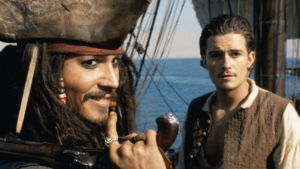
Johnny Depp’s Oscar-nominated performance as Captain Jack Sparrow is the star of this show. He is a charismatic-yet-bumbling pirate that, in the first 20 minutes of the film, sails his rinky-dink boat to 18th century Port Royal, Jamaica, tosses the British dock worker three shillings when the cost is only one, and then promptly rescues the governor’s daughter, Elizabeth (Keira Knightley), after she faints off a cliff into the rough-water oceans below. While he wins the affection of Elizabeth’s father (Jonathan Pryce), he is still a filthy pirate. A loss in a duel with blacksmith Will Turner (Orlando Bloom), who pines for the damsel, sends Captain Jack to prison. But when Barbossa (Geoffrey Rush) — the new captain of the Sparrow’s Black Pearl ship after he lost it in a mutiny — kidnaps Elizabeth, it’s Will who needs Captain Jack to retrieve his future bride.
Now, you’d think Barbossa would be interested in all the gold in the land, or some sort of ancient medallion, and then he’d unhand Elizabeth like an empty bottle of rum. Ted Elliott and Terry Rossio’s throws a curveball into the plot. You see, Barbossa and his shipmates happened upon some cursed Aztec gold many moons ago. Initially, it afforded them anything they could ever want: food, libations, sex.
However, the curse of the gold was that the food in their mouths would soon taste like ash. The rum would have the taste and effects of saltwater. And the lust was never satisfying enough. Eventually, Barbossa and his crew became skeletons, and now must live with the curse unless they receive a blood offering from each member. Enter the complexity of former crewmember “Bootstrap” Bill Turner, who was thrown overboard long ago. Barbossa believes Elizabeth is Bootstrap’s daughter, leaving her as the missing piece to complete the ritual and lift the curse.
Hear me out: Elizabeth has been infatuated with pirates and swashbuckling lore since she was a little girl, as we see in the opening scene of the film. She possesses a piece of the aforementioned Aztec gold; Barbossa takes note of this shortly after kidnapping her. There’s a version of Verbinski’s film in which Barbossa explained the need for a drop of her blood to use in a ritual to rid him and his crew of the curse, and, in the same world, she would oblige their request. One of the most admirable details about Knightley’s Elizabeth is she’s not a dame in need of rescuing. She is strong, self-reliant, and dependable. The treatment she receives from her governor father, which includes stuffing her into a corset, and even Will suggest they don’t know her like Captain Jack comes to know her. She is the type to be agreeable with Barbossa’s request, if he just asked nicely.
The Curse of the Black Pearl is so nimble and idiosyncratic that you don’t think of wrinkles like these as shortcomings of the plot. You don’t even question them in the moment. There is a “go with the flow” energy with this concept that suggests it was brewed organically, and not the byproduct of a long-running, nostalgic Disneyland attraction that launched when Nixon was president.
By this point in his filmmaking career, Verbinski was behind one of the most talked-about horror movies of the decade (The Ring) and a cultural touchstone for 80s/90s babies in MouseHunt. Beyond knowing how to cultivate atmosphere on whatever a story might require, the Polak named Gore is a natural when it comes to capturing events on a large canvas. Similar to how Spike Lee told the story of Rosewood through the eyes of multiple individuals and generations of performers, Verbinski commandeers a cast of all ages and guides them through a vast array of set-pieces, special effects, costumes, and massive displays that threaten to tower over their innate talents. Between Verbinski’s confident shots and scale, Dariusz Wolski’s classically minded photography, and Elliott and Rossio’s balance of narrative and spectacle, The Curse of the Black Pearl is stirring in the way it grabs you early and enthralls you with its dynamic storytelling.
My review of Pirates of the Caribbean: Dead Man’s Chest
My review of Pirates of the Caribbean: At World’s End
My review of Pirates of the Caribbean: On Stranger Tides
My review of Pirates of the Caribbean: Dead Men Tell No Tales
Starring: Johnny Depp, Keira Knightley, Orlando Bloom, Geoffrey Rush, Jack Davenport, Jonathan Pryce, and Zoe Saldaña. Directed by: Gore Verbinski.

About Steve Pulaski
Steve Pulaski has been reviewing movies since 2009 for a barrage of different outlets. He graduated North Central College in 2018 and currently works as an on-air radio personality. He also hosts a weekly movie podcast called "Sleepless with Steve," dedicated to film and the film industry, on his YouTube channel. In addition to writing, he's a die-hard Chicago Bears fan and has two cats, appropriately named Siskel and Ebert!