Film reviews and more since 2009
Publication Date: 01-08-2026
The Last Class (2025) review
Dir. Elliot Kirschner
By: Steve Pulaski
Rating: ★★
The 2013 documentary Inequality for All was my introduction to professor, political commentator, and former Secretary of Labor Robert Reich. Since then, I’ve been a follower of Reich’s on multiple platforms and come away learning something new every time I read his writings. In a country now poisoned by partisan rhetoric, sickening extremism, and the deepening pool of AI slop, Reich’s direct, unpretentious style of prose is curated to educate and resonate. If you, like myself, consider this deeply upsetting inflection point in America our “Years of Lead,” consider Reich the soft voice with the pointed perspective on economics, politics, and who’s really pulling the strings.
In 2022, at 76-years-old, Reich decided to retire from academia after 17 years of teaching at Berkeley. The new documentary, The Last Class, is an account of his final semester. Expectations can be the precursor to disappointment. I was primed to review the new doc, for I thought it would play similarly to something like Steve Jobs: The Lost Interview insofar that it would position the viewer as a fly-on-the-wall — or, more accurately, a student auditing the class.
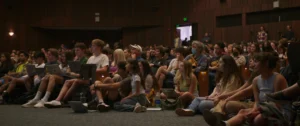
Instead, Elliot Kirschner’s documentary is a rather slapdash video collage of Reich talking to the camera, mingling with students, narrating campus B-roll, and occasionally, standing tall (short? He’s only 4′ 11″) in front of a lecture hall of a few hundred students. Reich’s musings are interesting because of course they are, if you’re a fan of his work, but rather than show what Reich does best, The Last Class chops and screws the approach by putting so many elements in a blender that nothing can sprout into something more than a pithy aside.
The subject of Reich’s final Berkeley course is wealth inequality, a subject he’s been addressing for the better part of six decades. If you’ve seen Inequality for All, you know Reich’s approach is a fascinating one. He taps into your emotions so as to connect with the material. He’s aided by bar graphs and data points, but he stops himself at various points to pose a question to his students: “how would you describe your upbringing from a financial standpoint?” Like any economist worth their salt, he relies on empirical data. However, like a great educator, he pulls his audience into his work by showing where they stand in relation to all the data.

At the time I watched Inequality for All, I was taking an AP Macroeconomics course in high school. My teacher was immensely smart, and practically strained to remain politically impartial. If a student asked a question that seemed to lean towards one side of the aisle, he would start his response with, “you could make that argument” and follow it up with, “the data tells us…” He lamented normative economics as another branch of confirmation bias, and lived and breathed empirical data. I laud him for it. But it was a class that, admittedly, was too advanced for me at the time (spoiler: I didn’t pass the AP Exam), and while I learned a barrage of economic terms, the teaching approach was cold and clinical. Reich not only bridged the intelligence gap for me, but also got me to recognize the broader economic spectrum of the United States. More intimately, he helped me understand why even my ardently conservative grandmother would say things like, “there’s money for all this other shit, but there’s no money for wages.”
But I digress, a lot like The Last Class, actually. This doc hopscotches around, with Reich expounding upon worsening income inequality in America; news as opinion journalism; publicly funded education; the role educators play in the lives of their students; etc. Surprisingly, a lot of his points romanticizing the profession of teaching ring hollow, for they feel more like template answers. At one point, he states how a good teacher instills both curiosity and critical thinking. I couldn’t agree more. But for a man with such astute observations and profound intellect, I expect more.
There’s an awful lot of telling in this documentary, and not much showing. The best scenes show Reich in the classroom, interacting with his students, breaking down the invisible yet rigid barriers of a large lecture hall by bringing students into his conversational monologues. For a man so short — Reich has multiple epiphyseal dysplasia, a form of dwarfism — he stands tall, and paradoxically, confidently humble. Outside of the classroom, when speaking directly to the camera, you can see he’s a product of a more cordial time in American politics before one side of the political aisle sought to backslide democracy like Michael Jackson’s moonwalk while the other passively watched and raked in donation money by crying helpless.
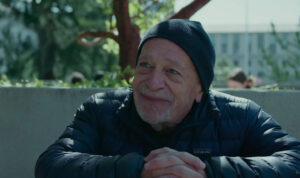
One telling scene comes when Reich talks about how he’s heard multiple students in recent years call themselves members of “the last generation,” as in ever. “Are you so laden with a sense of doom that you believe everything will end?” In an interactive poll in one of his lectures, the overwhelming majority of college kids surmise that they are pessimistic about the future of the world, yet optimistic about their own personal futures. Reich tells them, pithily, “pessimism is fine. Cynicism is not.” That’s kinder than the George Carlin quote I’ve been using since March 2020: “It’s never going to get any better. Don’t look for it. Be happy with what you got.”
A streamlined approach to Reich’s final class would’ve been a far more compelling documentary. Maybe we would’ve gotten to learn about a couple of his pupils, who took it upon himself to visit him during his office hours. Perhaps we would’ve been able to latch onto at least one chapter of his teachings before the film whisked us away to another setting and presented an entirely new idea. The nonlinearity of The Last Class is its undoing, and even undermines the finality that is Reich’s absence from the classroom setting at a time when his brilliance needs to be instilled on the next generation.
My review of Inequality for All
Directed by: Elliot Kirschner.

About Steve Pulaski
Steve Pulaski has been reviewing movies since 2009 for a barrage of different outlets. He graduated North Central College in 2018 and currently works as an on-air radio personality. He also hosts a weekly movie podcast called "Sleepless with Steve," dedicated to film and the film industry, on his YouTube channel. In addition to writing, he's a die-hard Chicago Bears fan and has two cats, appropriately named Siskel and Ebert!