
Film reviews and more since 2009
Publication Date: 01-21-2026
Auto Focus (2002) review
Dir. Paul Schrader
By: Steve Pulaski
Rating: ★★★
Paul Schrader’s Auto Focus puts a magnifying glass above one of the quirkiest rise and fall stories Hollywood has yet to see, which took place at the end of World War II and right through the rise of the free sex movement in the 1960’s. It’s a powerful film in the regard that, unlike a tangible addiction to alcohol or a narcotic that leads to a person’s downfall, it depicts an addiction to sex and pleasure, two things that many of us regard as positives in life. How can both things be wrong when they feel so right? Using the story of Hogan’s Heroes actor Bob Crane, Schrader constructs a story that shows addiction to pleasure and the consuming and unrelenting grip it has on a person.
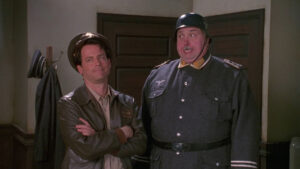
We follow Crane (Greg Kinnear) during his humble beginnings as a radio host for numerous different stations across the country, boasting a lively and energetic personality whilst starving for work as an actor. When handed the initial script for Hogan’s Heroes by his agent, Crane was stunned to see humor stemming from a German POW camp and thought of the show as nothing other than career suicide. Nonetheless, he took the gig, as it was a rare starring role for a relative no-name actor like himself, and after some short-lived controversy, Hogan’s Heroes was one of the most watched sitcoms on TV at the time.
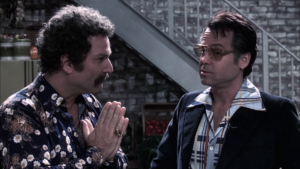
On set one day, Crane meets John Henry Carpenter (Willem Dafoe), an electronics expert who has a fascination with new and developing technology. John, nicknamed “Carp,” introduces him to the home video market and a new video-camera, and before-long, entrances Crane with the idea of filming their own pornography together. Crane and Carp eventually wind up seeking out beautiful young women at strip clubs and dive bars to take back to their hotel rooms and shoot videos with before cutting and editing the videos (and the many Polaroids), some for private use and some for distribution. While Carp sees this all as strictly business, Crane, a former churchgoing, straight-laced family man with a wife and two kids, becomes deeply immersed in the underbelly of illicit sex and pornography, quickly becoming an addict.
The problem here is, unlike most addicts, Crane didn’t see much harm in what he was doing, to himself or the countless amount of women he affected. “A day without sex is a day not lived” was his motto, and despite the growing frustration and eventual divorce from his first wife, Crane continued to shoot Hogan’s by day and shoot other things by night. During this time of the film, Schrader more-or-less captures Crane’s activities in an innocuous, almost flirtatious, manner that ostensibly comes from Crane’s excitement with working on set. However, when Hogan’s Heroes is long off the air and Crane finds himself doing dinner theater as a means of primary income, Schrader begins to focus on Crane’s eventual descent into sex addiction.
Crane personifies why sex addiction is so hard not only to fight but to admit at the very least. Crane is cocky and assured throughout most of the picture, boasting a clean-cut outfit at all times, neatly combed air, and teeth so white they could be bleached. He was the epitome of an American movie star in looks and, with monstrous mainstream success, it’s understandably difficult for him to see how he could’ve had a problem; he must have been doing something right. Not to mention, the sex Crane was having felt amazing; his love for all kinds of women and breasts made him happy and, really, what’s a little sex every day?

Paul Schrader is the ideal soul to direct Auto Focus, but the downside to his approach is that this film is never as seamy as it could be. Schrader’s love and fascination for man’s damnation by self and the underbellies of the world is something that often results in a great, immersing film in terms of character and setting (see Hardcore and Taxi Driver if you need further proof). The problem here is that Auto Focus, even during its seamiest scenes, feels tame and half-baked. We never get fully immersed in what kind of nastiness Crane was getting himself into, nor do we see Crane really fall or plummet physically and mentally as is typical for these films. Perhaps this is Schrader distracting us from all the noise in order to give us something more insightful and contemplative, but I still can’t help but feel that Auto Focus isn’t as dark as it could be.
The final twenty minutes of the film, however, shift the tone of the project ever-so carefully to create a moodier atmosphere so delicately that one can only wish this was the tone the film used throughout the last hour. Even Schrader’s camerawork becomes more methodical and focused – as if it itself autofocused – and Jeffrey Greeley and Fred Murphy’s cinematography becomes visually bleaker and almost akin to a neo-noir. It reminds when Schrader’s controversial Hardcore, concerning a Calvinist man going in search of his daughter when he realizes she has joined the adult industry, began to have its main character embark into pornographic casting calls and seedy adult bookstores in order to find his daughter.

Having said all that, the performances here alone are worth the price of admission; Kinnear, an actor given far too few serious roles, handles Bob Crane, a rather basic but troubled character, with a remarkable amount of subtlety and authenticity. Kinnear develops mannerisms for Crane synonymous with the common man, almost turning him into your kind-hearted neighbor you’d never expect to commit such ugly, evil acts of sin. Alongside Kinnear is Dafoe, another immensely talented soul that communicates the possibility of being sexually attracted to Kinnear’s Crane in a way that matches and never undermines Kinnear’s nuanced approach.
The final scene of Auto Focus is a brutal one, but one recreated to a tee — even the bedsheets and Bob Crane’s sleeping position mirror the actual events. If you’re lost at this description, I recommend you stay that way until you watch the film. With that, Schrader has made a film that, while nowhere near as explicit and seedy as it could’ve, and probably should’ve been, takes a real and seriously crippling addiction and, much like Crane’s character, decorates it to the point where sometimes the audience asks what exactly the problem is. If you can do that to a film like this, you’ve really got the story, character, and subject matter down.
Starring: Greg Kinnear, Willem Dafoe, Rita Wilson, Maria Bello, Ron Leibman, and Michael E. Rodgers. Directed by: Paul Schrader.

About Steve Pulaski
Steve Pulaski has been reviewing movies since 2009 for a barrage of different outlets. He graduated North Central College in 2018 and currently works as an on-air radio personality. He also hosts a weekly movie podcast called "Sleepless with Steve," dedicated to film and the film industry, on his YouTube channel. In addition to writing, he's a die-hard Chicago Bears fan and has two cats, appropriately named Siskel and Ebert!