
Film reviews and more since 2009
Publication Date: 01-21-2026
Punishment Park (1971) review
Dir. Peter Watkins
By: Steve Pulaski
Rating: ★★★½
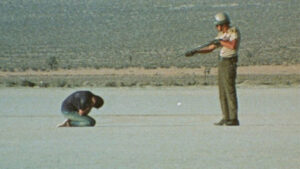
Peter Watkins’ Punishment Park is a compellingly brutal film, serving as commentary on the polarization of America and the treatment of those with unpopular viewpoints in the Vietnam-era. Shot in 1971 on a miniscule budget, the film offers its ideology on American youth at the time, the dehumanization and corruption of government, and the torment of people, with the looming thought that they may have not even been doing anything wrong.
The film was one of the very first to be shot in the style and tone of “Cinéma vérité,” a technique used by filmmakers to generate a documentary-like vibe and to persuade the audiences into believing what they’re seeing is real footage. It is 1970, and the Vietnam War is escalating, with president Richard Nixon losing control and running out of options. He declares America is in a “state of emergency,” and proposes the “McCarran Internal Security Act of 1950,” which gave federal authorities the right to detain those who appeared as a “risk to internal security.”
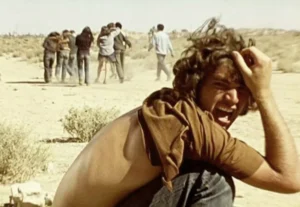
We follow members, mostly young university students, of various political movements, such as the feminist movement, the anti-war movement, the civil rights movement, and the communist movement who are arrested and given the choice of either serving their full time sentences or spending three days at the ambiguously named “Punishment Park.” Many of them choose the second option, where they are told that if they can run fifty-three miles in brutal California desert heat and make it to an American flag checkpoint, with a two hour head-start before National Guardsmen and federal authorities are dispatched to try and stop them, that they will be released and their pending dues will disappear.
As we see many young students run helplessly through the desert, with temperatures well over one-hundred degrees, we focus on another group of students who are pleading their cases to a group of men and women in a tent on why they were resisting and evading the Vietnam war. The people are simply not interested in hearing their views and constantly interrupt them, leading to contentious interactions involving heavy cursing and strong morality and ethics that increasingly come into play as time goes on.
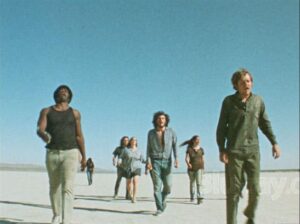
The cinematography is as raw as they come, with extensive shots of desert locations inhabited by sweaty, breathless students desperately clinging to their last hope for survival and humanity-driven choices. Watkins directs this picture with numbing realism that stems not only from the provocative cinematography, but from the screenplay, composed of extemporaneous dialog and improvisation on the actors’ part. Their performances are coldly real and chillingly authentic.
Punishment Park sort of tires out in its third act, being that it greatly established its point and purpose within the first two, but the film relentlessly tries to depict a brutal reality filled with dissent, isolation, and strict government control that thankfully never was prophetic. What is amazing is despite ones assumption that the film’s ideology and issues are dated and no longer relevant, in a post-9/11, Patriot Act, NDAA world, it would appear we must look onto films like these as poetry for the present.
Directed by: Peter Watkins.

About Steve Pulaski
Steve Pulaski has been reviewing movies since 2009 for a barrage of different outlets. He graduated North Central College in 2018 and currently works as an on-air radio personality. He also hosts a weekly movie podcast called "Sleepless with Steve," dedicated to film and the film industry, on his YouTube channel. In addition to writing, he's a die-hard Chicago Bears fan and has two cats, appropriately named Siskel and Ebert!