
Film reviews and more since 2009
Publication Date: 02-05-2026
The Little Girl Who Lives Down the Lane (1976) review
Dir. Nicolas Gessner
By: Steve Pulaski
Rating: ★★★
When the harrowing images of the Vietnam War entered homes in the 1970s, coupled with the hippie panic in the decade prior, the Manson family, and blissful, white American domesticity being at risk of perversion, movies featuring violent, problematic children began permeating American cinemas. Long before Larry Clark got to work in the 1990s, a plethora of American filmmakers found angles in examining otherwise traditionally middle-class families being torn about by kids who appeared hellbent on wreaking havoc, moreso than having a tantrum in the toy aisle.
The Exorcist, The Omen, and even The Bad Seed and Kill, Baby … Kill! all had their day, and are remembered fondly, but then there’s The Little Girl Who Lives Down the Lane. The 1976 Jodie Foster vehicle — amidst a busy year, with Bugsy Malone, Freaky Friday, Echoes of a Summer, and of course, Taxi Driver (for which she was nominated for an Oscar) being released within the calendar — premiered at Cannes and attracted considerable controversy due to subject matter and one particular scene. Viewed today, while it might seem tame given the hoopla it caused, Nicolas Gessner’s film is a well-acted, chilling work that threaded the needle of being an effective thriller and a character-driven drama.
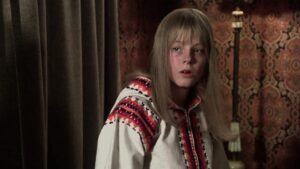
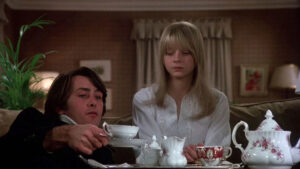
Based on Laird Koenig’s 1974 novel, the film follows Rynn (Foster), a mysterious 13-year-old girl, who lives in a comfortable home in a seaside town. She’s besieged by nosy neighbors, to whom she claims her poet father is with her, but he’s never around. Sometimes, it’s Office Miglioriti (Mort Shuman), and sometimes, it’s Mrs. Hallet (Alexis Smith), the landlord. However, nobody compares to Mrs. Hallet’s son, Frank (Martin Sheen), who turns up unannounced and makes thinly veiled sexual advances towards Rynn. On Halloween night, Frank slithers his way inside Rynn’s home, touches all her knick-knacks, repeatedly asks about the whereabouts of her father, and does things no well-meaning adult would do with a child present.
Rynn is the talk of this coastal town, and she claims her father is always stowed away in his study writing prose. Foster manages to convince us because she is so stone-faced and matter-of-fact with her words. With her bangs flirting with her eyelids and her ten-mile, deadpan stare, she’s able to sell truth to lies and ice to Eskimos. Oddly enough, the biggest detriment to Rynn’s safety are the adults who constantly pester her at every turn.
One day, Rynn meets Miglioriti’s nephew, Mario (Scott Jacoby), an aspiring magician, whose eccentric nature stymies Rynn’s steeliness. Despite spending many days alone, Rynn doesn’t realize that she’s lonely until Mario shows up, or worse, leaves her. The two share a morally-questionable-yet-endearing relationship; one that’s built on mutual dissatisfaction and empathy.
Foster is phenomenal as Rynn. At a tender age, Foster is capable of delivering lines with the coldness they require or the matter of fact tone they aplomb. Once you get over the fact that it was Foster’s 21-year-old sister, Connie, who climbed into bed with Jacoby’s Mario, and not the underage Foster, you might be able to see just how beautiful and realized their relationship is. Both Foster and Jacoby have adoring chemistry between, and their candlelight dinners are just as romantic as their late-evening snuggles. Anyone who has ever found solace in a friendship predicated on mutual shittiness and general contempt will likely find their union as heartwarming, puritans be damned.
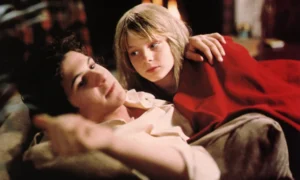
The other performance of the hour is Martin Sheen. Long before he became a household name after playing instantly memorable characters as Gordon Gecko, Sheen has the rare quality of being entirely unpredictable every time he steps on screen. When he enters Rynn’s home, he functions more like a stage actor than a conventional performer, familiarizing himself with the setting, trapesing around the area, touching various knick-knacks, and toying with our underage lead while doing so. Sheen’s prowess in commanding — no, stealing — scenes makes him feel scarier and more fleshed-out than Freddy Krueger could ever dream to be.
Amongst many other things, The Little Girl Who Lives Down the Lane feels like a true showcase for children insofar that their performative skills amongst adults, both well-intentioned and predatory, is far beyond what we might expect. When you consider the ubiquity and necessity that is the internet, long after Gessner’s film was released, you realize how much faster children must grow up. Gone is their innocence, their sense of ignorance. Foster’s Rynn is someone who arguably hasn’t had innocence since she was a little girl, and oh how great it must feel to be admired by a slightly-older boy who sees her for the beautifully independent soul she is. Gessner’s film is complicated. Treat is as such.
Starring: Jodi Sheen, Martin Sheen, Scott Jacoby, Mort Shuman, and Alexis Smith. Directed by: Nicolas Gessner.

About Steve Pulaski
Steve Pulaski has been reviewing movies since 2009 for a barrage of different outlets. He graduated North Central College in 2018 and currently works as an on-air radio personality. He also hosts a weekly movie podcast called "Sleepless with Steve," dedicated to film and the film industry, on his YouTube channel. In addition to writing, he's a die-hard Chicago Bears fan and has two cats, appropriately named Siskel and Ebert!