
Film reviews and more since 2009
Publication Date: 02-16-2026
Crazy Heart (2009) review
Dir. Scott Cooper

By: Steve Pulaski
Rating: ★★★
 Remembering Robert Duvall
1931 – 2026
Scott Cooper’s Crazy Heart is a successful drama for one very big reason and that’s its willingness to adopt the slow, languid movements of its protagonist. Inspired by the drinking, drugging country outlaws that propelled the genre to national relevance from the late 1940s to the 1960s, the film revolves round Otis Blake, known by his stage-name “Bad Blake,” played by Jeff Bridges. At 57-years-old, he’s a booze-hound sniffing for chump-change, forging a modest living for himself by playing in dive-bars and broken-down roadhouses, and after five marriages meriting nothing more than heartbreak and an estranged 28-year-old son, his drifting life echoes that of Luke, as the road and scuzzy motels are his only homes.
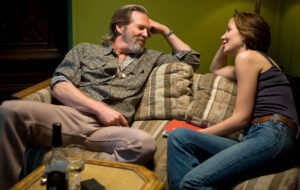
Then comes Jean Craddock (Maggie Gyllenhaal), an idealistic journalist with a young son (Jack Nation) that interviews Blake after one of his shows in order to pen a cover-story for the newspaper. The two strike fancy in the most humble of ways, as she tries to dig deep to get him to discuss his relationship with his son, Tommy Sweet (Colin Farrell), a popular country musician. Their talk leads Blake to muster up the motivation to reunite with his son, serving as his opening act for a handful of shows as his relationship with Jean plays out. As anyone with two eyes can see, Blake’s health is rapidly deteriorating, and it takes all but the length of a country mile for his newfound gig to spiral out of control due to his excessive drinking and reckless behavior.
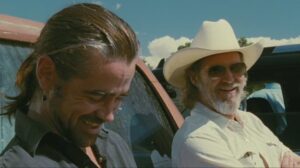
Although based on Thomas Cobb’s novel of the same name, which was loosely based on the life of country singer Hank Thompson, the film reminds me a great deal of Waylon Jennings, a fast-living, heavy-drinking country singer who married famous and birthed the gifted rockabilly artist who calls himself Shooter. Blake possesses the same rugged, outlaw spirit Waylon did, the noticeable country drawl in his voice, as well as the stench of rejection from corporate outlets such as the Grand Ole Opry. Jeff Bridges gives another one of his mannered performances, only this time, in the most unkempt fashion, playing down-and-out the way only his veteran presence can. His dialog is delivered with his typical mossy tone, where about 75% of his words are clearly understandable, and his accent an exercise in linguistical/regional twang. If you’re going to watch a has-been destroy themselves and every opportunity that comes their way for an upwards of two hours, it never hurts if said has-been is played by Bridges.
It’s a shame that Maggie Gyllenhaal, an actress I’ve never truly loved as an actress especially in love-interest roles, doesn’t compliment Bridges like she should. At the same time, however, I went back and forth on whether or not I wanted a character to truly come around an appropriately accompany Blake. He’s a character who is frankly unworthy of companionship after five failed marriages, a complete disregard for his son, and a lack of motivation to change the very downtrodden, contemptible parts of his character. The prolific divorces from country singers like George Jones, Waylon Jennings, and others leads the average person to believe these were men that should’ve remained alone due to their inability to properly accompany or treat the women in their lives. After all, without some semblance of lonesomeness, where would we get all those aching country ballads?
Crazy Heart captures the spirit of the broken-down, aging country spirit, refusing to hold back its depiction by painting the character so authentically. Scott Cooper illustrates the landscape of the south the only way he knows out, by showing the sweat, humidity, and shattered dreams that make up the area like a mural. He’d go on to direct films like the gritty, underrated Out of the Furnace, a drama set in the Rust Belt, and Black Mass, a uniformly solid mob-drama bearing his same appreciation for the dilapidated industry of the area. His style isn’t a pretty one, but it’s a pretty accurate one.
One finally musing on Crazy Heart, that I admit to you with self-awareness that it’s nothing more than a rant. Bad Blake is a fictitious character, as has been established, yet the unknowing viewer could easily mistake it for being a true story. That indicates that the film is not only well-done in a narrative sense, but believably authentic – not to mention the film was a sizable box office success. Why Johnny Cash can get the masterful, Oscar-nominated biopic Walk the Line and a fictional country outlaw can get a movie but Hank Williams gets stuck with a bogus ode to minimalism in The Last Ride and a sloppily conceived tell-all film with I Saw the Light will never not suck and never not be an injustice to country music.
Starring: Jeff Bridges, Maggie Gyllenhaal, Jack Nation, Colin Farrell, and Robert Duvall. Directed by: Scott Cooper.

About Steve Pulaski
Steve Pulaski has been reviewing movies since 2009 for a barrage of different outlets. He graduated North Central College in 2018 and currently works as an on-air radio personality. He also hosts a weekly movie podcast called "Sleepless with Steve," dedicated to film and the film industry, on his YouTube channel. In addition to writing, he's a die-hard Chicago Bears fan and has two cats, appropriately named Siskel and Ebert!