Film reviews and more since 2009
Publication Date: 02-16-2026
In Jackson Heights (2025) review
Dir. Frederick Wiseman

By: Steve Pulaski
Rating: ★★★
 Remembering Frederick Wiseman
1930 – 2026
FOREWORD: Despite coming at the age of 96, and preceded by what could be called a colorful life, the death of Frederick Wiseman is an immense loss for the world of film. By any metric, Wiseman is the greatest documentary filmmaker in the history of the medium. His contributions to the world of cinema and a vast array of subjects — art, cuisine, culture, commerce, small-towns, diverse neighborhoods, institutions, and more — much like his character, cannot be overstated. Watching Wiseman’s films not only made me a better film critic, but a better person. Take a moment and explore his filmography on his website, Zipporah Films. May his memory be eternal.
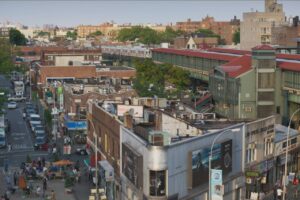
Frederick Wiseman’s In Jackson Heights is a film that examines what it really means to be a community in present-day America. Through Wiseman’s prolific inclusions of street-shots of the titular neighborhood and social events that take place within its multicultural landscape, he shows his admiration for a community that has erected its own culture by way of salad-bowl integration. Rather than bleeding together and making one area where everybody looks the same and, by and large, does the same activities, Jackson Heights operates in a way that makes that very notion unthinkable for this neighborhood, as it’s inclusive and different with every city-block. It makes you question, if you’re a suburbanite like me, if there really is any kind of valid or worthwhile community in a town characterized by a modestly populous downtown area, a handful of strip-malls, houses, and apartment complexes.

For a little over three hours, Wiseman treats us to the wonderful sights, sounds, smells, and sanctity that Jackson Heights provides its residents and even passersby. With a sound-track comprising four different languages – English, Spanish, Arabic, and Hindi – to accommodate the vast amount of cultures present in the neighborhood found in the borough of Queens, New York, Wiseman takes a look at an area that experiences a different problem than the usual gentrification. Instead of a crisis of community being ever-present in the film, as we might expect, the contentious point is the incongruous, disconnected relationship between citizens and their local government. Call that a problem present everywhere, but take note of the disappointment in a Spanish-speaking business-owner’s voice as he laments the fact that he voted for a Latino representative who has done nothing besides get involved with scandals since getting elected into office. Also notice his tone as he blasts politicians, particularly men and women of color, for campaigning heavily in diverse communities such as Jackson Heights and then effectively disappearing and discarding the storied neighborhood until it’s time for reelection.
Another moment before this concerns a fellow Spanish-speaking business owner, who realizes his decision not to vote in the recent election with an important proposition about taxes on local businesses counted as a “yes” vote. He proceeds to talk to his family and friends before a community organizer about how difficult it is to run a simple food-shop and have to put up with strict health code regulations but also taxes that ostensibly work to cripple and starve out local businesses in order for massive corporations with tax-breaks to prosper. This reminds me a lot of the Chicago suburbs, which exist not too far from where I’m at. A manager at a local tamale manufacturer told me when I picked up a large order one day something I won’t soon forget. “Once you see places [like Portillo’s, Five Guys, Mariano’s high-end grocery store etc] come into neighborhoods like this, and do well,” he said, “it’s only a matter of time for places like this.”
But business isn’t at the top of Wiseman’s agenda in terms of what to profile in Jackson Heights. He takes creative liberties in showing campaign offices with interns and secretaries that direct and deal with calls from curious or frustrated constituents that need answers to concerns about ongoing local happenings. A great example of Wiseman’s rhythmic editing, done without the use of title-cards or narration, comes when he bounces back and forth between two ladies that are dealing with angry callers. Although we don’t hear the voices on the other end of the phone, the wearied expressions of the very formal, restrained women say more than flustered callers ever could. We get the idea here and there, especially as one tells the caller, “that’s a gross misunderstanding of federal law, ma’am” after him or her evidently ramble about the safety of children and homeless people.
Wiseman even stops for some pleasantly comedic diversions in the form of my personal favorite – a driving school for Bengali, Punjabi, and Hindi speakers. Held in a low-rent, subterranean room with no windows that does little else besides remain efficient for a classroom atmosphere, the school is taught by a goofy but informative professor who instills the basics in his students of all ages and backgrounds. At one point, he tells an aromatic student an easy way he can remember the order of the cardinal directions by way of an acronym: “Never, ever smoke weed.”
In Jackson Heights is simply poetry in motion in the middle of its most graceful, engrossing scenes. The only setback is Wiseman’s tendency to linger a bit too long on some sequences, particularly an organized meetup of mostly illegal immigrants who discuss their experiences with getting to the United States, several of them harrowing and uncomfortable from the sound of it. Our documentarian’s decision to stay with these subjects for an often extended period of time likely stems from their stories being a key part in his interest in the Jackson Heights community as a well-rounded whole. He seems so taken by the dozens of cultures manifesting together to perform this area that’s quite literally colorful and, by the end, explosive as the common-thread of the American Dream and simple living in a big, sleepless city rests so prominently in the background. It’s compelling thematically but not so much conceptually, and often leads to a lot of scenes that last longer than they maybe should have. It’s interesting to note since this setback didn’t appear so much of an issue in Wiseman’s 2013 film At Berkeley, which was an hour longer than this.
But In Jackson Heights is just as sweepingly collective as it is intimately personal. A final note on a touching, if poignant, scene in the film involves a woman in her mid-nineties, spending her days largely confined to a nursing home, getting by in her wheelchair following the death of her husband. Speaking of the nurses that care for her, the woman tells some of her acquaintances, with a disheartened tone in her voice, “they don’t talk to me, and for that you pay $2,000 a month.” The woman is said by her friends to be exorbitantly wealthy; how wealthy is not clear but what is clear, from the woman’s expression, is she has no idea how to spend her accumulated wealth. She sits idly for most days, even joking (maybe) about paying someone to have a meaningful conversation with her since all of her friends and known family members are dead.
It is at this moment where another, far more understated theme brews in In Jackson Heights, undoubtedly one of dozen that could be erected from such an impressionistic work of pure documentarian journalism. It’s the idea that wealth and class are overrated sociological concepts in Jackson Heights. Most folks are seen working hard, making enough to get by, and living as simple as anyone I can think of in such a big city. By showing an elderly woman struggle to come up with ideas on how to spend her earnings, perhaps there’s a commentary embedded in Wiseman’s three hour odyssey through a layered city that accumulating wealth is meaningless if you can’t even enjoy it upon retirement – you might as well fasten a comfortable life while you can still move around and have people around you to share it with.
Directed by: Frederick Wiseman.

About Steve Pulaski
Steve Pulaski has been reviewing movies since 2009 for a barrage of different outlets. He graduated North Central College in 2018 and currently works as an on-air radio personality. He also hosts a weekly movie podcast called "Sleepless with Steve," dedicated to film and the film industry, on his YouTube channel. In addition to writing, he's a die-hard Chicago Bears fan and has two cats, appropriately named Siskel and Ebert!