
Film reviews and more since 2009
Publication Date: 03-03-2026
Pleasantville (1998) review
Dir. Gary Ross
By: Steve Pulaski
Rating: ★★★
Gary Ross’ Pleasantville functions best as zippy, dreamlike entertainment as opposed to a commentary on American culture. Its convictions get messy when it tries to make the case that 1950s America was exactly like how it was portrayed in sitcoms such as The Andy Griffith Show and Leave it to Beaver, something most, other than a fraction of American society, can vouch for, I am sure. As a piece of entertainment with a fascinating and lively world, which transcends its black and white cinematography, the film works quite well and I presume that will mostly define its legacy for years to come.
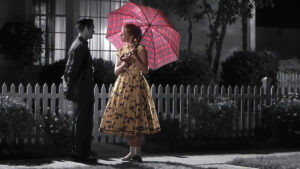
Following the opening credits, we’re introduced to David and Jennifer (Tobey Maguire and Reese Witherspoon), two young teens navigating high school in the 1990s. While Jennifer fusses over a boy she wants to date, David seeks refuge from his parents’ divorce and his loneliness by watching and memorizing details from a 1950s show called “Pleasantville.” The show is a regurgitation of every time-period-specific cliché you can name, from the unassuming soda-jerk (Jeff Daniels), to the white picket fence which protects the nuclear family known as the Johnson’s, “Pleasantville” plays dual roles for David – an electronic babysitter while his mother frustratingly talks to his father on the phone and comfort food.
On the night where a marathon of the show will be taking place in addition to Jennifer’s big date with her crush at the house she has to herself, the siblings fight over the remote control rough enough to break it. Consequentially, a TV repairman appears out of the blue and gives them a special remote that transports both of them into the TV show of “Pleasantville” upon being pressed.
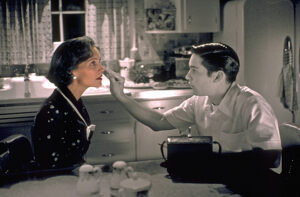
David and Jennifer wind up going from vanilla nineties teens to scrappy brother and sister Bud and Mary Sue, existing with in the conservative, constraining neighborhood of an environment with all the depth of a diorama. David instantly recognizes the pair’s place in the show; Bud is the optimistic, if somewhat deviant, brother, and Mary Sue is the best gal judging by her popularity with most of her class, including the attractive Skip (Paul Walker in a very early role). Their parents in the show are the square but well-meaning George and Betty (Joan Allen and William H. Macy), who mostly take a backseat to the events of their children.
David, in particular, begins to realize how sheltered and unknowing the citizens of Pleasantville are to anything resembling larger societal issues and concerns. Emotions other than extreme positivity or contentment are foreign to them, much less racial and socioeconomic issues, as are things such as fire, locks, and even rain, loaning the world to the artificiality of sitcoms. But everything runs and operates in a black and white sort of ode to social functionalism in Pleasantville, until the deviance of David and Jennifer begins to thoroughly take over, as they introduce them to emotions, art, and things that will help remove the wool from over their eyes. As time goes on, characters begin to slowly approach colorization with sections of themselves illuminating in the natural color of their clothing as imperfections and humanity within them begins to surface.
Pleasantville lends itself to multiple interpretations; so many that I’m not sure even Ross knows exactly what he is trying to say. Instead of a cultural critique, the film exists more soundly as a sociological examination of the pollution of the aforementioned idea of social functionalism. Theorist and social critic Talcott Parsons once described society’s rate of being successful dependent on the operation of things similar to that of a system, such as a vehicle or an assembly line. If all is primed and in working order, society – like a vehicle – can smoothly drive along forward, but if it was disrupted by something – say a broken spark-plug – society’s, or a vehicle’s, progress would be dramatically hindered.
With that being said, it’s hard to see the film as a worthy critique of American society in a realistic sense given that we’re dealing with a town made up of people so sheltered they’ve never seen rain. Imagine proposing the idea of water fountains for all races and radical things such as civil rights and equal employment opportunities for men and women to the mild-mannered citizens of Pleasantville. They’d be more frazzled and uneasy than those who heard the line “Frankly my dear, I don’t give a damn” from Gone With the Wind in theaters back in 1939.
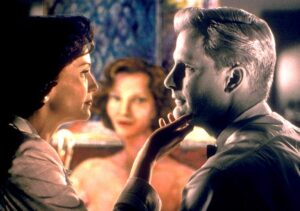
While it’s hard to take Pleasantville seriously in a more socially relevant context, the film mostly succeeds and rebounds with its premise, which is well-executed. The shift from reality to television is artfully done and notably different tonally, it’s a visual feast in terms of keeping its background details and aesthetic vibrant and interesting despite the black and white cinematography, and the performances are committed and fit their characters. Maguire brings the emotional power to Bud, and Witherspoon hits a bit of a walk-off homer with Mary Sue late in the film, leaving us emerging the film convinced she fit her role when it most demanded her skill (nonetheless, she’d ultimately be better suited for her role in Alexander Payne’s witty Election, which was released the following year).
Ross and cinematographer John Lindley (Field of Dreams, You’ve Got Mail) also make sure Pleasantville, despite the undeniable squareness of its population, can sustain a film as one of its only settings, and through it all, the two succeed in pulling off that task the best.
Pleasantville would make a fine film to show a high school sociology class or a very basic course on urban/suburban developments as a way of facilitating – not supplementing – conversation on larger, more pertinent issues. Ross’ wishy-washy attitude to addressing the moral fabric of America then and now as well as not making any hint to suggest that this is not the way society ever operated, I’d argue, in a film less convincing or affectionately acted, would be a massive disservice to the film’s story and concept. The rebound here is quite commendable, but if Pleasantville had paid a little bit closer attention to culture of yesteryear, it might’ve found success enough not to more-or-less play defensively towards its concept in the last act.
Starring: Tobey Maguire, Reese Witherspoon, Jeff Daniels, Paul Walker, Joan Allen, William H. Macy, and Giuseppe Andrews. Directed by: Gary Ross.

About Steve Pulaski
Steve Pulaski has been reviewing movies since 2009 for a barrage of different outlets. He graduated North Central College in 2018 and currently works as an on-air radio personality. He also hosts a weekly movie podcast called "Sleepless with Steve," dedicated to film and the film industry, on his YouTube channel. In addition to writing, he's a die-hard Chicago Bears fan and has two cats, appropriately named Siskel and Ebert!