Film reviews and more since 2009
Publication Date: 03-29-2026
Passage à l’acte (1993) review
Dir. Martin Arnold
By: Steve Pulaski
Rating: ★★★½
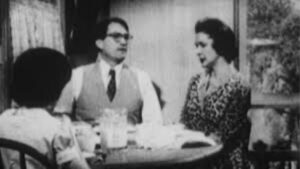
Passage à l’acte takes roughly ten seconds from To Kill a Mockingbird and makes it an eleven minute short film by, essentially, putting its audio and visual track on a metaphorical turntable and spiraling everything into distortion. The result is a hypnotic auditory assault that relies on patterned out noise and nonsense for the entirety of the short’s runtime. Sometimes funny, sometimes odd, and sometimes agonizingly repetitive, it’s one of the most curious oddities of film I’ve yet to see.
Extracting a meaning from this is like trying to find a sand grain in a bag of dirt. While it may be there, good luck trying to find the exact spec that makes the process worthwhile. Because this is a work of experimentation, I find the meaning rests in the purpose of what Martin Arnold found fascinating enough to warrant the existence of Passage à l’acte. To me, that’s the versatility and incredibly manipulative form of sound and film. The dialog in this short, composed, from what I can tell, of largely fragmented sentences said in a straight-forward, unambiguous manner by the actors, seems like it only has one way of being said. It isn’t until Arnold slows the dialog down, speeds it up, interjects other noises and lines of dialog over it, and loops it to a degree that recontextualizes the material entirely. For what purpose? That’s for you to decide.
The manipulation of sound here is a huge reason, I feel, Arnold even bothered essentially remixing a rather unremarkable scene from one of American cinema’s most beloved classics. The dialog in this To Kill a Mockingbird scene is so far past distorted it doesn’t even mirror English; even the visuals become convoluted in the film, in addition to the sound effects, with Scout’s concluding kiss on Atticus’ cheek sounding less like a kiss and more like a repeated chomping at his cheek.
As far as its contribution to the world, it manages to either be the funniest eleven minutes of one’s life, or the most agonizing, depending on how you look at it. It almost seems like one of the original internet memes, though it was made long before the internet was. At only eleven minutes long, it manages to go by fast enough where the joke doesn’t become old or repetitive (paradoxically so), but long enough to fully realize the absurdity of the entire act.
Auditory manipulation and the use of diegetic sound has long been a factor in cinema and Passage à l’acte showcases what can happen when audio is distorted far beyond any kind of comprehension, to the point of being a series of audio patterns that, when looped, produce both comedy and tedium. It successfully manages to arbitrarily break down the anatomy of an ordinary scene in To Kill a Mockingbird right down to each noise and sound. Its existence is questionable, and a reward for patient viewers may not even exist; it’s an absurdist way to break down and experiment by taking a straight-forward moment in a film and making it anything but.
NOTE: As of this writing, Passage à l’acte can be viewed on YouTube, free of charge.
Directed by: Martin Arnold.

About Steve Pulaski
Steve Pulaski has been reviewing movies since 2009 for a barrage of different outlets. He graduated North Central College in 2018 and currently works as an on-air radio personality. He also hosts a weekly movie podcast called "Sleepless with Steve," dedicated to film and the film industry, on his YouTube channel. In addition to writing, he's a die-hard Chicago Bears fan and has two cats, appropriately named Siskel and Ebert!