Film reviews and more since 2009
Publication Date: 04-20-2026
Leaving Neverland (2019) review
Dir. Dan Reed

By: Steve Pulaski
Rating: ★★★½
NOTE: This review was written back when Leaving Neverland premiered on HBO and HBO Max back in early 2019. As of late 2024, the documentary has been removed from HBO Max and the network’s programming, never to be formally released again, due to the result of a lawsuit from Michael Jackson’s estate. This review is for archival purposes.
Review of Leaving Neverland: Part 1:
It was only a matter of time before a documentary like Leaving Neverland was made. The sexual abuse allegations against Michael Jackson are widely known, but even after they were extensively reported, and resulted in settlements out-of-court, Jackson’s death in June 2009 seemed to erase the cloud of suspicion that had left a stain on the fabric of his legacy. Topics regarding Jackson’s acts of child molestation transitioned to examining his influence, undeniably elaborate dance-moves, and how his dozens of memorable songs had worked to transform pop music.
But Leaving Neverland gives shape and context to that swirling tornado of information that are the abuse allegations, and two men have bravely come forward to share their stories in a heart-pounding, deeply uncomfortable documentary.
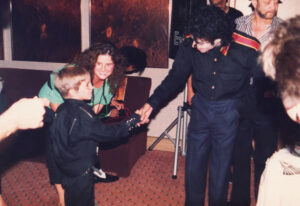
Shown at Sundance in its entirety before being sold to HBO and split into two 120-minute parts for television, Leaving Neverland focuses on Wade Robson and James Safechuck, two men who share their stories of their relationship with Michael Jackson in vivid detail. The specifics of their accounts are aided by their surviving family members and artifacts in the form of archival footage, letters, photos, and memorabilia they obtained from their time spent with Jackson as young boys. Their accounts, too, work to humanize a global superstar who had probably more power than any one human being ever should, not to mention the subsequent influence on society and media that helped keep stories like these from ever being told at his expense.
Robson and Safechuck were both young, sensitive Australian boys when they more-or-less fell onto the career-path of working alongside Michael Jackson. Robson became infatuated with Jackson at a young age, watching tapes of his music videos before seeking to embody his spirit by dressing up like the King of Pop. He was permitted to perform at a Michael Jackson dance competition at the age of five, and left such an impression on Jackson’s media people, and the crowd, that he was awarded the grand prize of meeting Jackson and attending his concert. Similarly, Safechuck began working in commercials around the same time, most famously starring in an early Pepsi ad with Michael Jackson, and was intoxicated by his spirit — but not as much as Jackson was in love with his. You wish the documentary would end after about 20 minutes and there was no more for the men to say, save for illustrating the total impossibility it was for them to meet such an iconic star when they were barely of school-age.
But unfortunately, there’s more, and the details Wade and James describe are graphic and gut-wrenching. James states how Jackson introduced him to masturbation, and how, for pleasure, he would pull apart his butt-cheeks while Jackson pleasured himself on the bed beside him. Eventually, that gave way to oral sex and other illicit behaviors in various presidential suites across the country. What’s more horrifying is how the men’s stories mirror in certain instances, such as how their parents’ hotel rooms would get further and further away from the rooms in which Jackson and their sons would stay, and how practicing the art of not getting caught was integral to their time together.
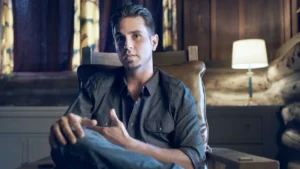
When Jackson bought Neverland in the late 1980s, James and his family accepted an invitation to live at the Ranch with Jackson over the summer so James could show off his dance moves on tour. By then, Jackson’s child-grooming tactics had worked so seamlessly that James would embrace staying with Jackson over his own parents. Both men, even as their timelines depart into their own separate, detail-specific instances of abuse, possess the same horrifying footnote of being slowly pulled away from their parents and thought to distrust their providers in favor of someone who preyed on their innocence and unfamiliarity with the life of fame. In one tearful monologue, James mentions how the misconduct seemed to be acceptable, at least in his eyes at the time, because Jackson made it clear how close they were as friends, and often spoke about how much he loved and adored their time together. Even if in the back of your mind you know something is wrong, when the person in question is subject to unprecedented fandom and adulation, how much are you willing to speak up when the culture around you reinforces that same person, let alone when you’re so young and powerless?
Wade, on the other hand, joined an Australian talent school after initially meeting Jackson. He tirelessly danced at various shows before his family finally helped take his talents across the ocean to the United States, where they got back into contact with Jackson. He and his family later got talked into staying at the idyllic paradise that was the Neverland Ranch. Wade mentions sleeping in the same bed as Jackson, along with graphic details about the two kissing, touching, and showering together.
Jackson famously got into show-business at a young age, working in conjunction with his siblings before enjoying a phenomenal solo career. His giggly, childlike behaviors suggest a man whose arrested development served as a crutch for not having a conventional childhood of his own, which would also explain him embracing the comfort of young children. At one point, James’ mother mentions how Jackson would spend the night at their home, and how she would wash his clothes and make him supper, all as if he was one of their own. He thought of the Safechuck residence as a safe-house of sorts. He tried to obtain normalcy through the boys and their families as he simultaneously made them obedient and subservient to his proclamations of love.
Leaving Neverland shows the dangers of idolization and the idea of unchecked power one infallible, global superstar can be anointed. Part one of the documentary ends with the men recounting how they came to discover “other boys” and “other families” Jackson began bringing to Neverland as they approached their teenage years, one of them being Macaulay Culkin of Home Alone fame. James’ mother states how she met another family at Jackson’s residence once, and remembers how standoffish they were — similar to how the Safechuck’s were, in large part because of how Jackson told them to be wary of others who might impede or question their relationship with each other. Trying to navigate life as a teenager is tough for anyone, but try doing it when a primary protector of you in your life, so you thought, begins to divide his attention between you and another stranger who begins getting all the love you were once used to. It’s a horrifying scenario, iterated in explicit, disquieting detail, as is many of the stories in the first part of a gripping, unsettling documentary.
Directed by: Dan Reed.
Review of Leaving Neverland: Part 2:
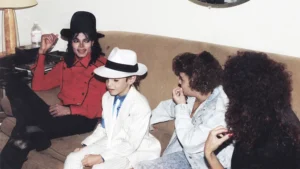
The second part of Dan Reed’s exhaustive, four-hour documentary Leaving Neverland focuses on Wade Robson and James Safechuck’s adulthood. Wade went on to be a coveted choreographer, crafting elaborate dance numbers for the biggest pop-stars of the early 2000s, such as Britney Spears and NSYNC, while James joined a band and pursued a career as a film director. As they grew older, both men saw more consistent contact with Michael Jackson only during the first trial against Jackson for sexual misconduct with minors, after a young boy named Jordy Chandler came forward saying that he was abused by the pop star.
In the early 1990s, when these allegations became prominent, the first thing the two boys did was deny. Whether or not they really grappled with what they were doing as a lie still confuses them to this day. Wade vividly remembers denying before police officers that anything illicit between him and Jackson took place, and James recalls answering all questions thrown at him about potential misconduct with an emphatic “no.” Perhaps it was the abundance of young celebrities, like Macaulay Culkin and Corey Feldman, coming out asserting nothing ever took place that convinced them nothing did happen. While his career was in jeopardy, Jackson actually bought James and his family a home and promised to kickstart James’ movie career upon convincing his family to pull him out of school. Jackson had such controlling tendencies over the families that only now does it appear clear as day, to James’ mother, Stephanie, specifically, that what he was doing was paying off the family in the wake of an ugly scenario.

In one of the film’s most troubling bits, Wade describes an encounter with Michael Jackson that involved anal sex and subsequently led to Wade scrambling to find his bloody underwear and throw it away before his mother saw it. That was the last sexual experience with Michael that Wade can remember.
Both men went on to get married and have children. Wade met his wife, Amanda, a promoter, at a night-club, while James met his wife, Laura, while he was performing with his band. Both men got a glimpse at normal, domestic life with these women who had no idea what Michael Jackson really did to them until much later in their marriage. For both Wade and James, two events made them truly grapple with the abuse: Michael Jackson’s sudden death in June 2009 and becoming a father. Long stretches in the film’s third act have all four parties discussing how their home-lives were soon left in tatters, as both Wade and James exhibited depressive and aggressive behaviors that led to self-isolation and nervous breakdowns. In particular, James had a baby and got attached to a huge movie project as a young director and quickly saw his life spiral before he backed away from everything.
Their abuse symptoms intensified. The thought of someone harming their own innocent children crept into their heads at separate but integral times during their later lives. Wade remembers having nightmares of Michael Jackson doing the same things to his child that he did to him, and even after testifying in Jackson’s trial in the early aughts, saying no sexual abuse occurred, Wade went public in 2013 saying just the opposite. James eventually went on to do the same.
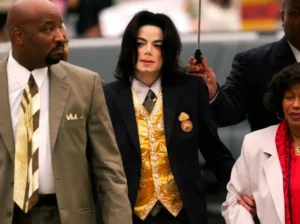
In its closing hour, Leaving Neverland does a strong job at confronting naysayers who will critique the clinical testimonies of Robson and Safechuck as being unemotional and, because of that, unbelievable. The two men talk extensively about what it was like to live in denial, and preach a lie so often that they themselves believed it to be true for many years. The documentary also doesn’t let the parents off the hook as easy as I initially thought. There will be a lot of people, myself included, stunned that parents would allow their child to sleep in a hotel room with another grown adult. But even then, getting hung up on that stalls everything; it doesn’t excuse what Michael Jackson allegedly did. “I didn’t protect my son and that will always haunt me,” Stephanie Safechuck, James’ mother, says towards the end of the film. There’s enough guilt and blame to go around.
Leaving Neverland is as gut-wrenching of a documentary as they come, equipped with no easy answers, stomach-turning details, and an “art vs. artist” debate that will last a generation and beyond. It’s not a stretch to believe that radio stations will begin pulling Michael Jackson songs from their library; that’s how sweeping and impacting this film has the potential to be. As a documentary, the film has a serviceable style, with its clinical and linear presentation, but that’s what these stories, after so many decades, deserve. Errol Morris might’ve brought a more investigative approach to the material, but Reed’s straight-forwardness and unglamorous approach coupled with the direct testimonies from Wade, James, and their families leaves nothing to the imagination.
My review of Captain EO (1986)
My review of Moonwalker (1988)
My review of Michael Jackson’s Ghosts (1996)
My review of Michael Jackson’s This Is It (2009)
My review of Bad 25 (2012)
My review of Michael (2026)
Directed by: Dan Reed.

About Steve Pulaski
Steve Pulaski has been reviewing movies since 2009 for a barrage of different outlets. He graduated North Central College in 2018 and currently works as an on-air radio personality. He also hosts a weekly movie podcast called "Sleepless with Steve," dedicated to film and the film industry, on his YouTube channel. In addition to writing, he's a die-hard Chicago Bears fan and has two cats, appropriately named Siskel and Ebert!