
Film reviews and more since 2009
Publication Date: 05-29-2026
Backrooms (2026) review
Dir. Kane Parsons

By: Steve Pulaski
Rating: ★★★½
The concept of “the Backrooms” originates from a post on the website 4chan, where a user posted a photo of an empty room underscored by ugly yellow walls, dingy lighting, and old wallpaper. It created a chain-reaction of other users that highlighted other aesthetics, which became known as “liminal spaces.” The concept is loosely defined as showcasing a large expanse of empty rooms, or the uneasy, eerie feeling that comes from seeing densely populated places (stores, waiting rooms, hotel lobbies) deserted.

Furthermore, consider the fact that most of these places depicted in various photos have been abandoned. Underscoring the eeriness is the appearance of these locations being “frozen in time,” with nuances in their building structure, carpeting, or something of that nature. This concept has resonated with younger millennials and Gen Z for reasons I’m not sure I can properly ascertain. But I can relate. In high school, some summer afternoons, my friend and I would walk around our suburban enclave, and occasionally make our way to a mostly desolate strip-mall. We would peer into the windows of closed businesses and point out the remnants that still existed.
I remember a local arcade that had closed over a decade ago at the time (circa 2014). Inside the still-unoccupied storefront was futuristic purple carpeting, a couple broken machines; pictures drawn by children still hung on the wall. I can vividly picture it. I wondered where those kids were now, how old they were, if they even remembered drawing those pictures, and whether or not they would want them. It wasn’t even noon, and the sun was shining, but there was an unshakeable eeriness to what I saw. Clearly, it’s stayed with me today.
Forgive the long wind-up, but Kane Parsons’ Backrooms might have you recalling some of those strange, liminal spaces you’ve come across in your own personal life. The 20-year-old Parsons made headlines a couple years ago when A24 hired him to direct a film adaptation of his Backrooms web-series, effectively making him their youngest feature director. All this time, I was pegging Parsons as someone who could kick open the door for the oft-marginalized millennial/Gen Z filmmakers to get larger opportunities with major studios. Curry Barker’s Obsession and its runaway, unprecedented box office success managed to deliver the first kick; Parsons might’ve just taken the door off its hinges.
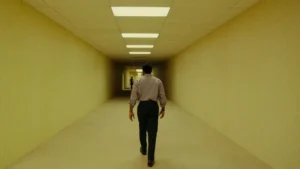
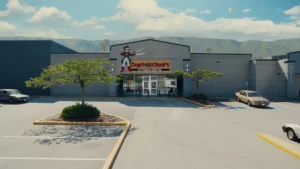
Set in the 1990s, Backrooms follows Clark (Chiwetel Ejiofor), a recently divorced owner of a failing furniture store, who still harbors intense resentment for his wife and his woebegone life. He regularly sees Dr. Mary Kline (Renate Reinsve), a therapist who encourages him to do a role-playing activity where he reenacts how his wife threw him out of his own house. Now, his home is the furniture store, Cap’n Clark’s Ottoman Empire, for which he does TV ads in a pirate costume while bragging about his surplus of living rooms, bedrooms, and dinette sets (“Flea Market Montgomery,” anyone?). It’s a tacky establishment with cheap furniture, and a building plagued by a crappy breaker system, and consequently, flickering lights.
Late one night, Clark literally walks through a wall of the furniture storm. On the other side is vast, empty room with sulfur-colored walls, structures that don’t make any logical sense, musty carpeting, and illuminated by several fluorescent lights. The deep into the room Clark walks, several more rooms start to appear. Some contain piles of incomplete furniture, some are partitioned. There is a constant hum that seemingly comes from the lighting fixtures. There is no purpose for this place, until there is.

Taking a concept with creepypasta origins and spinning it into the yarn of a larger film is a Herculean challenge. The crew behind the 2018 film Slender Man found that out the hard way. While Parsons’ web-series expanded upon the mythology of the Backrooms, the fact of the matter is that everyone has a different relationship to the core concept. Seeing vast arrays of empty, meaningless rooms can inspire one person to roll their eyes in disinterest, repressed memories for another, or complete-and-total engagement. I was completely locked into Parsons’ Backrooms from the start. Stumbling upon the 4chan post when he was only 16, and utilizing his own creative methods online, the still-green, almost-unfathomably young filmmaker has a Lynchian-esque style of craftsmanship when it comes to setting the mood and letting ambiance breathe.
The first hour has Parsons and screenwriter Will Soodik masterfully setting the table for this concept. They don’t spoonfeed us information; they allow us to follow Clark in his own exploration with long stretches sans dialog and action. Your mileage will vary. I found it immersive and haunting. I didn’t need concrete answers, I was fully content with being absorbed in the arresting nothingness of these settings (over 30,000 square-feet of them). The fascinating undercurrent of these Backrooms is there’s no reason for them to exist. They are not purgatory. They are not hell. They are simply mysteries wrapped in enigmas. You’re not put in one as a punishment, nor is there necessarily anything present looking to harm you. You’re simply stuck. What an awful fate.
Soodik’s material plays into how different people respond to the Backrooms by way of Clark’s experience, and later, Mary’s, when she arrives at Cap’n Clark’s in search of her patient. For Clark, these rooms are an escape. For Mary, they’re an entrapping reminder of her hellish childhood.
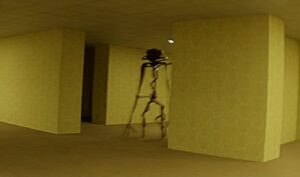
The latter is explored with a bit of clunkiness in the third act. Soodik’s writing remains sharp during a pivotal scene between Clark and Mary, but starts to wear as it struggles to land the plane. I’m not sure if Mark Duplass’ scientist character was necessary to the paradoxically lean-yet-lofty material, but hardcore Backrooms fans might tell me I don’t know what I’m talking about. Even as someone who tends to scoff at ambiguity in horror, the Backrooms concept isn’t one that loans itself to hearty justifications. This is very much an “is what you make of it” movie and moviegoing experience, which, for me at least, is a large part of the allure.
Cinematographer Jeremy Cox has large canvases on which to work, and it can’t be overstated how difficult it is to make largely barren, aesthetically perplexing spaces feel like they’re full of everything from dread to discovery. He finds a plethora of ways in which to shoot these rooms, all while retaining focus on Ejiofor and Reinsve’s intense facial expressions. He knows how to enhance the mood through his framing, the same way in which Edo Van Breemen and Parsons (also a credited composer) intermix fragments of synths, pixelated audio, and incoherent noise into what amounts to daring creative music choices that enhance this atmospheric experience.
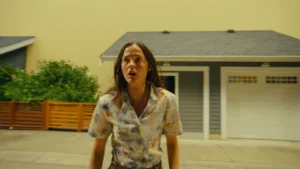
I surmise that The Shining will be a popular point of comparison, but I think Backrooms is very germane to the rise of “analog horror,” where the focus is on replicating the lo-fi VHS aesthetic that dominated the late 20th century. Present in the soundtrack is a lot of the whirring you’d typically hear if you rewound a VHS tape in an old player. There are a couple deftly conducted first-person POV sequences where handheld cameras posit you as the explorer of the Backrooms. In some ways, Skinamarink set the table for this analog horror subgenre to flourish. Films like this and Late Night with the Devil are progressively advancing the style.
I’m Pete Repeat, I know, but what a phenomenal time to be a horror fan. The current generation (Jordan Peele, Zach Cregger, Ari Aster, Robert Eggers, Scott Derrickson, and Oz Perkins — a credited producer on Backrooms) is thriving. The new generation, Curry Barker and Kane Parsons, is already hitting the ground running. Ominous thuds engineered to make the audience jump are going by the wayside in favor of concepts both concrete and opaque, visual styles that span eras and countries, and a gaggle of new faces (Inde Navarrette) shining and familiar ones (Demi Moore) showing another side of their acting acumen. The playing field is so vast and full of imagination that no Backroom could contain it.
NOTE: I wrote about the original “Backrooms” photo‘s origins in Oshkosh, WI for Y105’s website.
NOTE II: Inspired by the passing reference to the viral “Flea Market Montgomery” video in Backrooms, I reached out to Sammy Stephens to discuss the origins of that video. We even discussed Backrooms in our conversation. Take a listen below!
Starring: Chiwetel Ejiofor, Renate Reinsve, Mark Duplass, Finn Bennett, Lukita Maxwell, Avan Jogia, Robert Bobroczkyi, and Krista Kosonen. Directed by: Kane Parsons.

About Steve Pulaski
Steve Pulaski has been reviewing movies since 2009 for a barrage of different outlets. He graduated North Central College in 2018 and currently works as an on-air radio personality. He also hosts a weekly movie podcast called "Sleepless with Steve," dedicated to film and the film industry, on his YouTube channel. In addition to writing, he's a die-hard Chicago Bears fan and has two cats, appropriately named Siskel and Ebert!