Film reviews and more since 2009
Publication Date: 06-06-2026
Power Ballad (2026) review
Dir. John Carney

By: Steve Pulaski
Rating: ★★★½
It’s probably not a huge surprise in the grand scheme, but when you put Paul Rudd and Nick Jonas together, in a film directed by John Carney, whose films show the visceral connecting power of music, you effectively get One Banger After Another.
Now, dear reader, I’m fully aware of the pitfall here. Did I like Power Ballad for its music, or for the movie itself? In musical terms, the music in the film is the chorus. The soundtrack is predicated on a great deal of cover songs, sung by Rudd (who dominates the OST), and the handful of originals, sung mostly by Jonas, are credible pop ballads with accompanying bells and whistles that keep his voice at the forefront (it reminded me of Elliott Yamin’s early music). That said, the bridge and the verses are made up of strong human drama. The purity of songwriting soon gives way to the oft-slimy nature of the music business, where artists are essentially manhandled by those whose interest in them is only measured by how much financial gain can be obtained from their success. For a movie that might get shoehorned into the occasionally pejorative “dad movie” genre, Power Ballad has a lot of depth in its production that rewards deeper discussion.
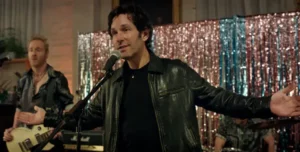
Rick Power (Rudd) is a wedding singer, who has been living in Ireland for 15 years fronting a band known as The Bride and Groove. “We’re not rockstars. We’re human jukeboxes,” one of his bandmates informs him when he decides to break from the setlist of “Celebration” and “Summer of ’69” to perform one of his own personal numbers (“Finishing Line,” a winning, original work of arena rock). Rick gave up on his rocker dreams when he met and married an Irish woman named Rachel (Marcella Punkett), and had his now 14-year-old daughter, Aja (Beth Fallon). He likes his life, yes, but he still yearns for the days when he was the leader of a band playing original tunes as opposed to danceable wedding staples. It’s evident by how he envisions a stadium of adoring fans watching him perform, only for the setting to fade into the reality of a handful of sweaty attendees shimmying in a crowded group.
During one gig, he meets Danny Wilson (Jonas), a former boy-band star, who is now 27-years-old and fighting for relevancy as his solo career flounders. Danny is a guest at a wedding at which Rick performs, and after the two take the stage and do a knockout rendition of Stevie Wonder’s “I Wish,” the two regroup after the wedding and decide to do a little noodling with chords and lyrics. Rick helps Danny fine-tune a song he’s been working on. Danny does the same, as the two pass a bottle of whiskey between them. Finally, Rick performs a song he’s been working on for many years.
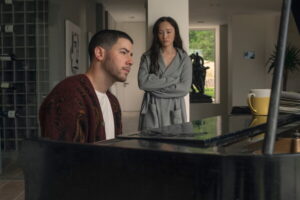
Back in his posh Hollywood Hills mansion, Danny performs that very song, called “How to Write a Song (Without You),” for his girlfriend (Havana Rose Liu). It’s immediately irresistible, its plot revolving around a singer who can’t find any inspiration to write if his one true love isn’t present. Danny records it, and it immediately becomes a breakout hit, garnering millions of views and streams, and vaults Danny back into superstardom. Here’s the problem: the song was written by Rick.
Cut to Ireland when Rick is at a shopping mall, and — in one of the film’s most believable instances — hears the song over the mall’s sound system. He knows he wrote it. The problem is it was so long ago that he cannot find a recording file of it, thus rendering him without proof that he is owed credit, and of course royalties. Repeated phone calls to Danny’s manager (a damn good and occasionally intimidating Jack Reynor) go unreturned, and without many options, Rick and his fellow bandmate, Sandy (Peter McDonald, also co-writer) fly to Los Angeles to confront the rising pop star.
Famous for other musically stories like Once (2007) and Sing Street, Carney’s work has largely went unseen by me, and I now realize that’s been a mistake. I’m told from what I’ve read that Power Ballad is one of his sadder features insofar that its story initially success a butting friendship only to descend into a bad-faith game of music politics. Such is life. That sad, Carney’s inclusion of music, be them Rudd-fronted covers or glimpses of original numbers from the youngest Jonas Brother, feels like a radiant beam of light that bisects the picture and elevates the existing mood. This is different from emotional manipulation; it’s something more tactile and meaningful, and it’s a device Carney has played with for so long, he’s evidently mastered it.
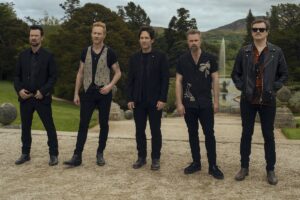
Recently, Rudd has been taking on projects that allow him to break from the shackles of being the attractive, irresistibly charming everyman. He was a total schmuck father in Death of a Unicorn, forced to be the bad guy in Friendship, and now finds himself in a role in which he goes from doting dad to a man with a one-track mind watching his dream be lived by someone he thought was his pal. The fact that he can sing just gives him another enviable dimension. It’s no surprise that Nick Jonas is a capable performer, and while a few more scenes of Danny honestly coming to grips with what he did to Rick would’ve been appreciated, he still sells those intimate scenes that show the guilt of his actions fester in his eyes.
With the success of A Complete Unknown and Michael, Hollywood will without a doubt continue to mine catalogs of indispensable artists to blow their stories up and oversimplify them for the big screen. That said, the recent success of Song Sung Blue and positive reception of Power Ballad shows an appetite for small-scale and fictious acts whose stories are perhaps more resonant with those who have just enough money to buy a ticket. Carney has clearly been a personal blind-spot for me for too long. I’ll start singing a different tune immediately.
Starring: Paul Rudd, Nick Jonas, Peter McDonald, Marcella Plunkett, Beth Fallon, Jack Reynor, Havana Rose Liu, and Sophie Vavasseur. Directed by: John Carney.

About Steve Pulaski
Steve Pulaski has been reviewing movies since 2009 for a barrage of different outlets. He graduated North Central College in 2018 and currently works as an on-air radio personality. He also hosts a weekly movie podcast called "Sleepless with Steve," dedicated to film and the film industry, on his YouTube channel. In addition to writing, he's a die-hard Chicago Bears fan and has two cats, appropriately named Siskel and Ebert!