Film reviews and more since 2009
Publication Date: 12-08-2025
Die Hard 2 (1990) review
Dir. Renny Harlin
By: Steve Pulaski
Rating: ★★★
Although I’ll admit I’m not the first one to give them the time or day or indulge in their self-plagiarizing escapades, action sequels are often fascinating in their conceit. They usually follow their predecessors quite swiftly and borrow extensively from them as well, despite lacking a principle actor, director, cinematographer, or someone who helped make the original “worthy” of a follow-up. With that being said, after revisiting Die Hard to see if it held up (as foolish as that sounds as to anyone who has confirmed that with themselves time and time again), I was atypically primed to see Die Hard 2. How do you follow a happy accident in both a critical and financial sense and how do you do it so quickly?
Coming not even two years after the original John McTiernan tour-de-force, Die Hard 2 borrows extensively from its predecessor in hopes to produce the same (but different) experience once again. It takes place on Christmas Eve. The villains are a group of highly skilled terrorists. John McClane is still as invincible as Superman in some instances. And he’s still not believed by men in power who wouldn’t get a second interview for the job they’re currently in if this series existed in the real-world™. Yet unlike the presence of derivative details and bumbling side-characters, Die Hard 2 is an acceptable, competent sequel even if it doesn’t double down on surprise and the direction doesn’t have that previous swagger.
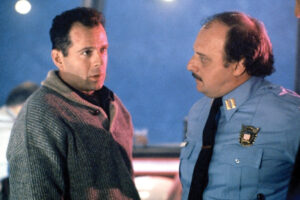
Die Hard 2 opens with Bruce Willis’ McClane arriving at Washington Dulles International Airport awaiting the arrival of his wife Holly (Bonnie Bedelia), who is arriving from LA. Upon having his car towed for being parked in an unauthorized zone, McClane’s rough holiday continues on the two-year anniversary from the incident at the Nakatomi Tower. He gradually learns the presence of a former Army colonel named Stuart (William Sadler), who along with a group of henchmen, take control of the airport’s air-traffic control systems and breach all direct communication with active flights. Men set up shop in a church, and make their demands clear: they want a vicious drug kingpin and dictator (Franco Nero of Django fame) released and cleared in lieu of his trial. Intercepting and seizing control of a plane would be the ideal method of escape, so they have Dulles go dark and keep all flights circling in the air as they run out of fuel — including the one with Holly on board. McClane leaps back into go mode, working with an incompetent police captain (Dennis Franz) and an airport director (Art Evans) in order to reinstate law and order.
Also returning are William Atherton, whose contemptible Dick Thornburg is traveling on the same plane as Holly, and Reginald VelJohnson, reprising his role as the resourceful Sergeant Al Powell, always eager to assist McClane in a pinch. Both men add familiarity to the film in the favorable sense of the world.
Let’s get the notable shortcomings out of the way. Colonel Stuart is no Hans Gruber and William Sadler’s serviceable villain shenanigans are not close to matching the air-raising ways of Alan Rickman in what could reasonably be described as one of his best performances. Furthermore, there’s the inescapable feeling of familiarity that washes over the film that didn’t exist in the original. When McClane narrowly escapes danger or gives Franz’s Captain Lorenzo a snarky response, we don’t admire it nor laugh the same way we did when he was mouthing off to 911 dispatchers while desperately trying to get help to the Nakatomi Tower.
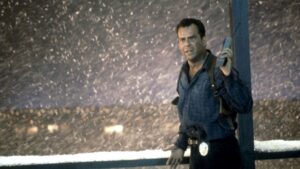
But all of this could very well make up the details of a black-and-white warning title card that would find its place before every subsequent action movie sequel. Die Hard 2 delivers the entertainment value at least I believe it should; where it succeeds is in giving us two hours of rollicking action sequences that further establish John McClane as a credible hero and Bruce Willis as a passionate actor when comfortable in the right role. Notably missing from this sequel, however, are the style-points that are the nuances as to why Die Hard is as beloved as it is. Director Renny Harlin’s (whose catalog consists of Cliffhanger, Deep Blue Sea, and the fourth Nightmare on Elm Street sequel) camerawork is at times slick, and in certain moments — such as when McClane ejects himself from a grenade-filled plane — precise and stylish. But it doesn’t match the way McTiernan’s turned a vertical structure into a winding, entrapping labyrinth of dead-ends and mystifying catacombs. Yet if all action films had as much style and flair as Die Hard and Die Hard 2, perhaps my motivation to seek out the myriad of sequels I’ve been missing would be a bit higher.
Die Hard 2 is a good follow-up, workable, taut, and kept afloat by Willis’ gruff exterior, Franz’s eminently hard-headed, incorrigible, personality, and Harlin’s willingness to try and keep an emphasis on the visuals. Some sequels take what could’ve been a terrific franchise and have all their standards and promise plummet into an abyss of mediocrity. Some are burdened by ultimately trying to capture lightning in a bottle and do so in a bumbling manner. Few surpass the level of quality set forth by their superiors. Die Hard 2 makes its case to exist to the point where it’s possible to forget we’re watching the same movie twice.
My review of Die Hard
My review of Die Hard with a Vengeance
My review of Live Free or Die Hard
My review of A Good Day to Die Hard
Starring: Bruce Willis, Bonnie Bedelia, Dennis Franz, William Sadler, William Atherton, Art Evans, Reginald VelJohnson, and Franco Nero. Directed by: Renny Harlin.

About Steve Pulaski
Steve Pulaski has been reviewing movies since 2009 for a barrage of different outlets. He graduated North Central College in 2018 and currently works as an on-air radio personality. He also hosts a weekly movie podcast called "Sleepless with Steve," dedicated to film and the film industry, on his YouTube channel. In addition to writing, he's a die-hard Chicago Bears fan and has two cats, appropriately named Siskel and Ebert!