
Film reviews and more since 2009
Publication Date: 05-13-2026
Fight Club (1999) review
Dir. David Fincher

By: Steve Pulaski
Rating: ★★★½
Seeing Fight Club on the big screen is a true thrill. Having seen a plethora of re-released films in theaters over the last month, including The Evil Dead and Cabin Fever, I recognize that while the best way to see a movie is experiencing it on the biggest screen in town, some movies benefit from an audience versus a large canvas. Based on Chuck Palahniuk’s novel, Fight Club pops on the big screen, and given its recent 4K remaster, it’s paradoxically never looked this good while still retaining its grungy aesthetic.
In 2009, in honor of its ten year anniversary, Dennis Lim of The New York Times called Fight Club the “defining cult movie of our time.” It’s hard to argue, as strange as it is. Contrary to what some may believe, especially if they didn’t experience its initial theatrical run in 1999, this was not some independent film made on a shoestring budget that just so happened to catch fire on home video. This was a massive, $60 million+ investment from Fox that boasted Brad Pitt in an against-type role helmed by the man responsible for Se7en. Sure, it barely recouped its budget and ultimately found its greatest success on VHS and the then-still new advent of DVD, but its appeal, particularly to young men, created controversy, intrigue, and above all, a mythology of sorts. Oh, to have been in college when this film was released — I could see myself having debates both enthusiastic and heated at a campus coffee shop.

Viewed today, it’s remarkably easy to see how so many disaffected, emotionally stunted men took away the wrong lesson from Fight Club, not to mention how it has been co-opted by the dreaded incel community. I suppose the most comparable film to undergo such a varied and sometimes downright reactionary analysis in recent time is probably Todd Phillips’ Joker. More disappointing is the media’s hair-trigger response, once again misconstruing depiction for endorsement. The fact that Fincher has had to come out repeatedly over the years and quell the notion that it glorifies a life of nihilistic violence — an idea perpetuated by the media at the time of its release — and denounce how the film has been embraced by certain masculinists, who I’m sure love to quote it on their insufferable podcasts, is another example of just how media illiterate many people are, despite spending so much of their life consumed by screens.
All of the surrounding noise makes Fight Club harder to appreciate on its own merits. But only if you let it. This full-throated, supercharged masterclass of acting, pacing, and forward momentum has a way of discarding any preconceived notions or discourse fatigue you might have — at least it does for me. Settling into my seat and seeing it begin with our unnamed white collar narrator (Edward Norton) contextualizing his doldrum, shopping magazine-dependent life as a recall coordinator, I was locked in like I was when I first watched it some-15 years ago.
Norton’s character is cynical but agreeable. He suffers from insomnia, and his physician recommends visiting a support group for people with testicular cancer to see “people with real problems.” I can imagine what the co-pay charge for that kind of diagnosis was. So, he does. He begins frequenting various support groups for something to do, and sees some improvement in his sleep. Before long, he meets Marla Singer (Helena Bonham Carter), another imposter who turns up to these groups smoking a cigarette — including the aforementioned meeting on testicular cancer, despite… y’know. Her presence unnerves him, so they agree to split up the groups as if they’re working out a custody schedule for their children.

Cut to the worst day of our narrator’s life — an airline loses his luggage and his apartment unit inexplicably explodes, destroying all of his possessions — and it’s when he meets Tyler Durden (Brad Pitt), a traveling soap salesman whose atypical view of life immediately captivates him. He agrees to live with Tyler in a dilapidated, leaky, utterly ugly brownstone in an unsavory part of town, where the two are essentially squatters. During this isolated “bro time,” Tyler teaches him about freedom, employment, and how jobs and money have enslaved men like them for too long. As a means of release, and a way to reclaim their primal, masculine desires, the two begin to physically fight one another. It becomes therapeutic. Soon, other men they meet want to get in on the action. Fight Club is birthed.
While a handful of recognizable supporting players make thoughtful contributions — including Meat Loaf as a testicular cancer survivor, and Jared Leto as a bleach blonde ruffian — the core three of Norton, Pitt, and Bonham Carter do their part to elevate Jim Uhls’ script. Norton has a chameleon quality as an actor that allows himself to sink into any character he plays. This is more evident given how he physically appears to waste away the longer the film goes on; his body becomes more gaunt and his eyes sink deeper and deeper into his skull. Known as the pretty boy of Hollywood for most of his career up until this point, Pitt clearly relishes playing a character as rugged and unchained as Tyler. Not only is his character unapologetically individualistic in his own pursuit of happiness, he’s also an idealized version of who our narrator wishes he was, and Pitt leans into that sort of impossibly “perfect” archetype with brash personality. Bonham Carter sees her strength in her own unbridled individualism as well, and whether she’s ensnared in the complex life of the narrator or the carnal exploits of Tyler, she finds herself being the most interesting person in the room every time.
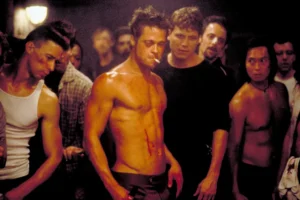
Fincher and cinematographer Jeff Cronenweth revel in pummeling the audience with a gritty, ugly visual scheme, complete with “cigarette burns” and a rapidly dwindling sense of reality. Because our perspective is that of Norton’s sleep-deprived narrator, the canted angles, intense close-ups, and otherwise warbly sense of reality makes the viewer feel like they’re progressively going insane. The combat scenes are brutal as well. Fincher isn’t going for artful style here, but rather, a true sense of the bloodshed that ensues from bare-knuckles boxing. It’s as frantic and as exhilarating as a fight you’d witness on a street corner.
Through gripping narration, unpredictable plot-points, and a constant desire to push everything from the narrative to the boxing scenes forward, Fincher’s Fight Club, I’d argue, is not just the defining cult movie of our time, but among the most important movies of the 1990s, arriving at the twilight of the decade before you could find whatever subculture, be it violent, alienating, or absurd, became accessible from your own home via the internet. Despite the cardinal rule of the film being not to speak about the titular underground activity, we as a culture can’t stop talking about it, and countless disenfranchised men can’t stop imitating the perils of what Uhls’ finger so delicately had its pulse on long before it was etched into the zeitgeist.
Starring: Edward Norton, Brad Pitt, Helena Bonham Carter, Meat Loaf, and Jared Leto. Directed by: David Fincher.

About Steve Pulaski
Steve Pulaski has been reviewing movies since 2009 for a barrage of different outlets. He graduated North Central College in 2018 and currently works as an on-air radio personality. He also hosts a weekly movie podcast called "Sleepless with Steve," dedicated to film and the film industry, on his YouTube channel. In addition to writing, he's a die-hard Chicago Bears fan and has two cats, appropriately named Siskel and Ebert!