
Film reviews and more since 2009
Publication Date: 07-22-2026
The Odyssey (2026) review
Dir. Christopher Nolan
By: Steve Pulaski
Rating: ★★★
Nine years ago, Christopher Nolan released Dunkirk to critical acclaim and fierce debate amongst cinephiles. If you were like me and saw the film in IMAX, you were engulfed by its impeccable sound design and towering images. If you saw it in a traditional theater presentation (known as “Digital Cinema Package,” or “DCP”), you might’ve felt like an added layer of dimension, be it in terms of sound or cinematography, was missing. If you saw it IMAX 70mm, you’re part of a privileged class I can’t even begin to comprehend.
Nolan’s highly anticipated The Odyssey has found itself subject to similar discourse regarding format and presentation. It is the first film to be shot entirely with IMAX 70mm cameras, a tremendous feat for sure. However, when you consider the fact that there are only 41 theaters in the entire world equipped to show the film in that format (including only 25 in the United States), then what good is it for the majority of the moviegoing public? Not to mention, when the vast majority of people watch this movie on their 32” – 70” televisions at home, where does all that extra sound, visual scale, and craftsmanship go?
Here I already am three paragraphs deep into discussing The Odyssey and I haven’t even talked about the film itself. This is what happens when technology takes precedence over storytelling. Going back to Dunkirk, after seeing it IMAX and I marveling at the experience, I found the film itself to be decent, as it treated individuals as part of a broader collective, which robbed it of an opportunity at humanizing those involved with the historic evacuation of some-38,000 soldiers. If you remember Dunkirk, you probably recall the experience in which you saw it as opposed to distinctive moments that were elevated by the actors, if you can remember who even starred in it.
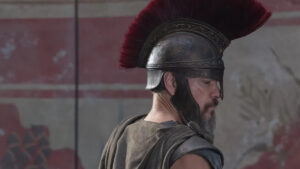
The Odyssey is a wonderful showcase of Nolan the craftsman. As a movie, it’s entertaining, but might leave you wanting in terms of how it sometimes smothers its large ensemble of complex characters under the crushing weight of aesthetics. It will behoove those who have read or at least familiarized themselves with Homer’s epic poem. For those of us who know fragments of it, such as the battle with Cyclops, the Trojan War, and Circe the witch, it compiles those vignettes of the larger poem together in what is an exhilarating display of cinema. But for those “less fortunate” to experience this film in a standard theater auditorium, bereft of the large-scale IMAX or the precious 70mm film, you start to feel the weight of the sound and adjacent mixing collapse onto itself. This results in something more muddled that I presume will only intensify when it inevitably becomes another movie you can stream on Peacock.
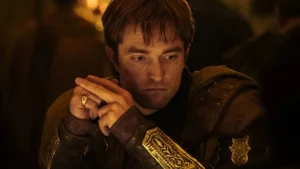
Nolan drops us into Ithaca following the Trojan War and disappearance of Odysseus (Matt Damon) following his decade-long journey. The King of Ithaca, Odysseus has failed to return home to his wife, Penelope (Anne Hathaway), and his now-adult son, Telemachus (Tom Holland). There’s infighting amongst the masses, who want to usurp the still-young Telemachus to become one of Penelope’s suitors, most notably Antinous (Robert Pattinson), a braggadocios coward who uses fear to mask his own insecurities.
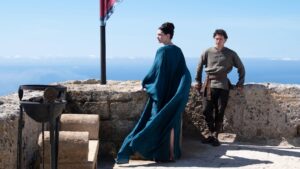
Meanwhile, Odysseus is marooned on an island, his lone companion being a nymph known as Calypso (Charlize Theron). Odysseus led his Greek army into the shores of Troy, and successfully breached its walls by concealing themselves in a large wooden horse the noble Sinon (Elliot Page) presented as a gift from the defeated. The ensuing war is the film’s greatest technical marvel as it confines the viewer inside the horse for a long period of time before showing the war strategy pay off for the Greeks in the first act, and the ensuing battle and aftermath later in the third. From there, Odysseus preaches to his army that obeying and honoring the Gods is the only way forward. This draws challenge and criticism from Eurylochus (Himesh Patel), Odysseus’ second-in-command, who views his actions as prioritizing the alleged desires of unseen entities over the wellbeing of his soldiers. The only real god to whom we’re introduced in physical form is Athena (Zendaya), who emerges as Odysseus’ protector during this long, painful journey.

The cast is uniformly strong, with Matt Damon giving one of the most dramatic performances in his long, varied career. An actor sometimes chided for his lack of range, he does well at exuding Odysseus’ bravery and self-doubt. Pattinson is another standout, channeling a seldom-seen smarmy side of his personality; the way he delivers lines like, “somebody get these beggars out of here!” with the nervousness and approval-seeking ticks of a novice comedian is rich. Pattinson likened his character to James Woods’ Lester Diamond in Casino, and with that I have nothing more to say. Phenomenal comp.
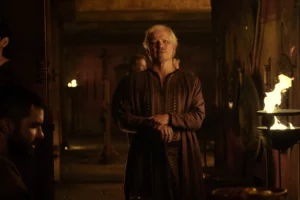
Hathaway and Holland are more integral to the story late in the film, but make the most of the screen-time they’re allotted early by imbuing their moments with tender emotion. Other players — including John Leguizamo as the blind Eumaeus; Page as Sinon; and Jon Bernthal as Menelaus, who is given one truly exceptional sequence where he relays a story of Odysseus’ bravery to Telemachus — are equally commendable. Still, I felt like for a film nearly three hours in length, there was more room for additional characterization for most individuals not named Odysseus, Penelope, or Telemachus.
Nolan insisted on greatly limiting the use of CGI when filming The Odyssey. That Cyclops you see? It’s a gigantic puppet. The thunderstorm and ensuing shipwreck were executed without the use of a green screen. The sounds of thunder will likely shake the seats and walls of your theater. Kind of like Top Gun: Maverick, it just feels different when it’s real. Being that we experience the journey through the eyes of Odysseus, his perspective of the events becomes ours. At frequent points, we might as well be rendered the size of a sprite when faced with the hulking creatures that move to attack him and his army.
In addition to the Trojan War, the other standout sequence involves Circe the witch, played by Samantha Morton in one of the film’s performances that might go on to be one of the most overlooked. If there were ever a hint as to what a Christopher Nolan horror movie might look like, this entire chapter gives us an idea. Elements of the scene made me recall Ingmar Bergman’s Hour of the Wolf in how it turns a pastoral setting into a hellish enclave of dread despite being captured in broad daylight.
The Odyssey does have something of a spiritual connection to Nolan’s Oppenheimer, at least in one of its themes. The idea Odysseus wrestles with is one that would feel squarely familiar to that of J. Robert Oppenheimer hundreds of years later. It’s the sickening feeling that you’re leaving your children with a world that is less safe than the one in which you were born. Furthermore, Nolan uses the “Golden Rule” principle of Zeus’ law — do unto others as you would have them do unto you — as the fundamental principle of our world that we as humans have lost, which has led to atrocities, contempt, anger, and unrest. The consequences of abandoning the golden rule are felt throughout the film. Where Nolan sometimes struggles to capture interpersonal relationships in his films, instead favoring (and excelling at) spectacle, he nails the through-line of the story here through both dialog, visuals, and an intense focus on Odysseus’ personal plight.

The downside is that you’re likely not getting the full experience of The Odyssey unless you have the ability to see the film in IMAX 70mm. A growing problem I’ve noticed in (predominately) American blockbusters is that they are becoming increasingly optimized for presentations and technology that even the vast majority of corporate multiplexes don’t possess. This leads to sound mixing that has a combination of music and ambient noises tromping on character dialog, rendering their speech muffled. Here, it results in Ludwig Göransson’s score “BRRMING” in a way that recalls how Hans Zimmer’s compositions sounded leaden in Nolan’s Tenet. Is this an argument that theater chains like AMC and Cinemark need to invest in widespread upgrades? Absolutely. But consider those who will soon watch The Odyssey on average, $200-500 television sets that lack external surround sound systems (who’s to say which models Nolan prefers?). This of course isn’t to say filmmakers shouldn’t experiment with filmmaking technology, but when such technology remains inaccessible for the vast majority of moviegoers, how fruitful is it for the general public?
My misgivings might’ve been lessened if for the first 30 minutes of the film I didn’t feel like I was wrestling to get acquainted with characters as if I missed additional context, or perhaps found a greater connection to the story’s most important figures beyond broad-stroke depictions of bravery and sacrifice. Or maybe if I would’ve made an odyssey of my own to a theater with an IMAX 70mm projection and scalped tickets to a screening, I’d come away feeling different. Like Dunkirk and Tenet before it, your reaction to The Odyssey will likely depend in significant part on how you were able to view it — as well as what you were able to absorb and what eluded you in the process.
My review of Dunkirk (2017)
My review of Tenet (2020)
My review of Oppenheimer (2023)
Starring: Matt Damon, Tom Holland, Anne Hathaway, Robert Pattinson, John Leguizamo, Zendaya, Charlize Theron, Himesh Patel, Jon Bernthal, Lupita Nyong’o, Samantha Morton, Elliot Page, and Benny Safdie. Directed by: Christopher Nolan.

About Steve Pulaski
Steve Pulaski has been reviewing movies since 2009 for a barrage of different outlets. He graduated North Central College in 2018 and currently works as an on-air radio personality. He also hosts a weekly movie podcast called "Sleepless with Steve," dedicated to film and the film industry, on his YouTube channel. In addition to writing, he's a die-hard Chicago Bears fan and has two cats, appropriately named Siskel and Ebert!