
Film reviews and more since 2009
Publication Date: 02-01-2026
Blue Moon (2025) review
Dir. Richard Linklater

By: Steve Pulaski
Rating: ★★★★
If one were to make a film revolving around the premiere of the now-timeless Rodgers and Hammerstein musical Oklahoma! back in 1943, there would be multiple entry-points for a writer. One could give it the Birdman treatment and show the bustle of the cast and crew in the hours before the curtain rises. Another avenue would be to explore the simultaneous excitement and anxiety Richard Rodgers and Oscar Hammerstein II undoubtedly faced watching their creation with an audience for the first time. Or, maybe the after-party setting could simultaneously act as an epilogue to the show’s premiere as well as the fast-moving elevator to Rodgers and Hammerstein’s unmatched success as collaborating show-business partners.
So, what direction does Richard Linklater, one of the best and most versatile American directors today, take with the material? If you guessed: the opening night premiere of Oklahoma! from the perspective of Lorenz Hart, Rodgers’ previous collaborator, as he drinks himself silly at a nearby bar before the final curtain call, then you’d be correct. A blackly funny yet undeniably tragic look at a man aware of his own rapidly dwindling relevance yet too dependent on booze and hopeless romantic connections to do anything about it, Linklater’s Blue Moon sings and swings like the best of Hart’s lyrics and the most infectious of Rodgers’ melodies.

Working off a script by Robert Kaplow, Blue Moon quickly gets into motion by having Lorenz Hart (Ethan Hawke) belly up to the bar at Sardi’s before Oklahoma! lets out. Hart has a gab-and-chatter with a bartender named Eddie (Bobby Cannavale) and a pianist he nicknames Knuckles (Jonah Lees), running the gamut of topics from Broadway to Casablanca, and eventually, a fact so undeniable that even he can’t skirt around it: Oklahoma! is going to be a massive hit. After Hart, a gifted lyricist that married his words so thoughtfully to Richard Rodgers’ scores, struggled to mine the mostly rural area for a story and songs that would justify a stage production, he had to watch audiences lap up the work his partner and Oscar Hammerstein put into a project that resonated with audiences from the moment the first line of dialog was uttered.
It’s not that Hart doesn’t have a repertoire worth celebrating. This is the man behind classic numbers like “The Lady is a Tramp,” “My Funny Valentine,” and of course, the title track, with its devastating lyrics, such as: “Blue moon, you saw me standing alone/without a dream in my heart/without a love on my own.” It’s that Hart is now stuck in professional quicksand. He lacks the confidence in his own voice to continue as a solo act, and he’s worked so long as a duo that he quietly knows that without the yin to his yang, whatever he writes will be insufficient.
The first 30 minutes of Blue Moon largely involves a rolling, deviating conversation between Hart, the bartender, the piano player, columnist E.B. White (Patrick Kennedy), and other floating individuals, such as waitresses, a flower-delivery boy, and a couple of soldiers. Hart doesn’t do as much wallowing in self-pity as I might have you believe. He’s actually gregarious, as many drunks are. He’s lively in his banter, tries to incorporate everyone into the conversation, and is quick with a joke, or to light up your smoke. Inevitably, audience members from the premiere begin making their way to Sardi’s, and so do Rodgers (Andrew Scott) and Hammerstein (Simon Delaney).
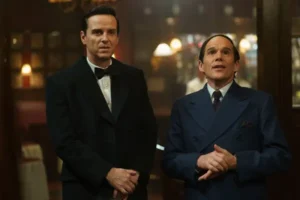
The scenes between Ethan Hawke — who had to be shot with forced perspective to give the illusion he’s a diminutive 4’10” in stature like the real-life Hart — and Andrew Scott are worth the price of admission alone. While trying to bask in the glory of his latest accomplishment, with a new partner who was very recently a stranger to him, Hart weasels for his attention amidst photo-ops and ample congratulations. Scott’s look of appreciation and disgust at Hart is palpable. He owes so much of his career to this man, but the resentment over his growing unreliability still lingers. The two share an extended moment on a staircase where they confront the issues that led to them going their separate ways. Hart wants to plot a new show with him; one that examines the life of Marco Polo. Rodgers proposes Hart write four or five new songs for a possible re-release of one of their previous works. Him and Hammerstein are already kicking around an idea for a musical set on the Maine coastline. Like most great duos, be them in movies, on TV, radio, or Broadway, Hart and Rodgers have enjoyed high highs and bitter lows together. They found their first tastes of success and failure at one another’s side, but the proverbial fork in the road has come and both are on clearly different paths. Rodgers is keenly aware that Hart, along with his drinking and self-loathing, is his own worst enemy.
The morsel of hope to which Hart clings is his relationship with a college girl named Elizabeth, played by Margaret Qualley, who looks like some substance has effectively transformed her into a 1940s actress. She’s half Hart’s age, and clearly only has use for him to the point that he can open doors and get her to rub elbows with luminaries of his status minus the crippling drinking habit, but he holds out hope for something more. The moments they share with one another are affecting yet heartbreaking because we get the idea that this might be the last time the two will ever have a meaningful conversation. And eventually, she all but confirms it when she reveals she would walk great distances for another significantly older man who doesn’t treat her half as well.
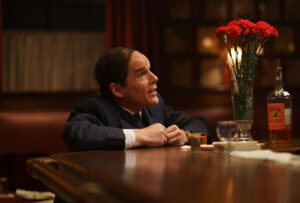
Kaplow’s dialog is richly eloquent, to the point where it so naturally assumes the role as the primary activity in the film. With a painted-on combover and impressively contorting facial expressions, Ethan Hawke delivers one of the most memorable performances of his career. His transition from a physically imposing child abductor to a pint-sized, neurotic artist should be a lesson in range for all aspiring actors. And then there’s Richard Linklater, who has long been fascinated by the psyche and private lives of artists (Me and Orson Welles), and has no trouble at all in making compelling movies about complicated characters (Bernie, Hit Man).
Blue Moon is a lesson for all creatives. Relevance doesn’t make a clear exit for stage left. Instead, it’s out of the room before you notice; meanwhile everyone suddenly has their attention elsewhere.
Starring: Ethan Hawke, Margaret Qualley, Andrew Scott, Bobby Cannavale, Simon Delaney, Patrick Kennedy, Jonah Lees, Cillian Sullivan, John Doran, Anne Brogan, and David Rawle. Directed by: Richard Linklater.

About Steve Pulaski
Steve Pulaski has been reviewing movies since 2009 for a barrage of different outlets. He graduated North Central College in 2018 and currently works as an on-air radio personality. He also hosts a weekly movie podcast called "Sleepless with Steve," dedicated to film and the film industry, on his YouTube channel. In addition to writing, he's a die-hard Chicago Bears fan and has two cats, appropriately named Siskel and Ebert!