
Film reviews and more since 2009
Publication Date: 02-17-2026
Eat a Bowl of Tea (1989) review
Dir. Wayne Wang
By: Steve Pulaski
Rating: ★★★
No one could fault filmmaker Wayne Wang for aggressively pivoting back to his roots following the catastrophic critical and financial failure of Slam Dance, which served as his mainstream American debut in 1987. The film was uniformly lousy, but clearly the fault of an editing and screenwriting lobotomy moreso than any directorial shortcomings, but most of all, it was the exact opposite kind of film Wang was making up until that point. It was so concerned with shoddily plotting the innerworkings of a murder mystery that it sidestepped the individuals involved, which Wang proved from the dawn of his filmmaking career, with Chan Is Missing, that was where his heart resided.
Eat a Bowl of Tea is cinematic course-correction for Wang, who managed to deliver my favorite of his works yet. Its narrative ties to his sophomore film, Dim Sum: A Little Bit of Heart, are undeniable, but the characters feel more developed, the culture shock for Chinese-Americans is stupendously conceived, and the dry comedy is executed with pinpoint precision. A great deal of that is also a credit to screenwriter Judith Rascoe, working off of Louis Chu’s 1961 novel, who brings out the best in her own abilities while Wang juggles a story that’s constantly shuffling us all over New York’s Chinatown neighborhood.
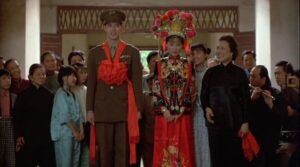
It’s 1949. We first meet first-generation Chinese-American Wang Wah Gay (Victor Wong), who, due to the Chinese Exclusion Act of 1882, was unable to bring his wife over to the States. Their son, Ben (Russell Wong), enlisted in the U.S. Army, and thanks to the War Brides Act of 1945, is indeed able to bring his immigrant bride, Mei Oi (Cora Miao), back “home,” so to speak. Whether they know it or not, Ben and Mei Oi’s marriage is about to be a union through which Ben’s father can live vicariously. Wah Gay and his flock of Chinese “bachelors,” one of whom played by Hong Kong comic actor Eric Tsang, soon turn their attention to monitoring Ben and Mei Oi. Don’t they know it’s about time they start having children?
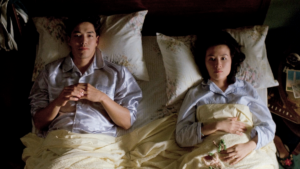
Consequently, Ben and Mei Oi must face the nearly impossible challenge of adapting to marital life (they essentially marry merely days after meeting), a new country, and color commentators on their union. Mei Oh quickly realizes that romantic theater dates are traded in for Ben’s long nights managing a restaurant. When the couple try and have children, Ben’s impotence gets in the way. It’s hard to get hard with a tornado of change happening and there’s no time to adjust. Mei Oh also realizes early that she’s not particularly keen on being a housewife whose interactions with her husband are limited to small talk. It’s as if they’re passive players in their own lives.
Remarkably, Wang and Rascoe keep things remarkably kind-hearted, which is something when you consider this is a movie that eventually incorporates infidelity and a murder attempt into its plotline. The latter is made out to be a work of slapstick, as a series of events leads to an elderly woman stepping on a severed ear. Moreover, we want to see Ben and Mei Oh succeed because of the unfair circumstances vested upon them. Familial pressures exacerbate hasty and therefore poor decision-making that, when considered for more than a moment, isn’t necessarily all their fault. The film’s title is a Chinese colloquialism to encourage thick-skinned masculinity (IE: “grin and bear it,” “take your medicine”).
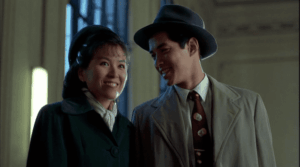
Russell Wong and Cora Miao are a delightful pair, even in spite of the disintegration of their love for one another. An actor who, at the time, had not been giving many premier roles, Wong feels like he comes-of-age as a leading man over the course of Eat a Bowl of Tea. At times, he’s shaky, but he radiates the kind of charm and fresh-faced energy that we love in our actors. Cora Miao (who starred in Wang’s Dim Sum) seems genuinely shy when we first meet Mei Oh as a reticent young woman whose relatives speak for her. Miao’s sharpness as a performer only increases when her character starts to find her own agency. One of the best scenes from both a comedy and staging perspective comes when the two are angrily packing their respective suitcases. Wang’s camera is stationary in front of their bedroom dresser, underscored by tacky wallpaper and religious photographs as the two robustly walk in-and-out of frame multiple times gathering their items before forcing them into suitcases that quickly become impossible to close — all while their bitching and moaning at one another doesn’t stop.
So difficult it is not to make this material bleak and grim — not to say it wouldn’t have been a good film had its tone been the opposite — but Wang and Rascoe manage to keep Eat a Bowl of Tea whimsical and light on its feet, no mosh-pitting or dead call girl required.
My review of Chan Is Missing
My review of Dim Sum: A Little Bit of Heart
My review of Slam Dance
My review of Life Is Cheap… But Toilet Paper Is Expensive
My review of The Joy Luck Club
My review of Smoke (1995)
My review of Blue in the Face
My review of Chinese Box
Starring: Russell Wong, Cora Miao, Victor Wong, and Eric Tsang. Directed by: Wayne Wang.

About Steve Pulaski
Steve Pulaski has been reviewing movies since 2009 for a barrage of different outlets. He graduated North Central College in 2018 and currently works as an on-air radio personality. He also hosts a weekly movie podcast called "Sleepless with Steve," dedicated to film and the film industry, on his YouTube channel. In addition to writing, he's a die-hard Chicago Bears fan and has two cats, appropriately named Siskel and Ebert!