
Film reviews and more since 2009
Publication Date: 02-24-2026
The Joy Luck Club (1993) review
Dir. Wayne Wang
By: Steve Pulaski
Rating: ★★★
“Years later, I had moved to America. But what I had done in China was always with me.” – Ying-Ying St. Clair, The Joy Luck Club
The Joy Luck Club was a massive achievement for Asian-Americans upon its release in 1993. It suggested the decades-long roadblocks for Asian performers were finally being torn down. Despite the film adaptation of Amy Tan’s novel being revered by critics and audiences alike, not much changed in terms of Chinese (and, more broadly speaking, Asian) representation in the biggest film industry in the world. Flower Drum Song, widely regarded as the first major American production featuring an Asian cast, suggested a tide was turning until it wasn’t in 1961. 25 years after The Joy Luck Club, Jon M. Chu’s blockbuster Crazy Rich Asians was heralded as the new boundary-breaker. Seven years after that film was released, not only has there not been a remotely comparable mainstream work, but a sequel to Chu’s box office success has languished in development hell.
The fact that The Joy Luck Club became a token of its era has nothing to do with its quality. In fact, I’d rather pivot here and remark about what a marvelous achievement is it for director Wayne Wang, whose filmography I started exploring this year. For a director with only one “mainstream” feature under his belt at the time (and what a disaster it was), coming off of a Godardian experimental film hardly anyone would see until the 2020s, Wang handles Tan’s monstrous, multigenerational story with pure poise.
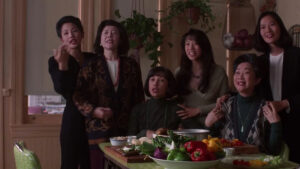
The Joy Luck Club revolves around four older Chinese women and their four adult daughters with a narrative scope that spans decades whilst offering a torrent of emotions. The framework is set in contemporary San Francisco, where June (Ming-Na), an American-born Chinese woman is invited to joint the “Joy Luck Club,” a weekly mahjong group consisting of her mother’s three best friends. June is invited following her mother’s (Kieu Chinh) recent passing. Resentful of her matriarch’s perfectionist stranglehold on her as a child, June has grown up insecure and reticent, but learns from her mother’s friends that she has two half-sisters still living in China. She must grapple with the decision of whether or not to pay them a visit.
Working off of a script by Tan and Ronald Bass, Wang interweaves this story with flashbacks revolving around June and her mother as well as the other women who make up the titular club. Lindo (Tsai Chin) had to use deception with the assist of Chinese ancestry to escape a rotten arranged marriage, but now struggles to pass on the same strength she used in China to her American-born daughter, Waverly (Tamlyn Tomita).
Ying-Ying (France Nuyen) has the most traumatic story of all, in my opinion. She marries a man (Russell Wong, who starred in Wang’s earlier film, Eat a Bowl of Tea) who appears perfect until he turns into a brazenly unfaithful, violent coward. Following years of abuse while trying to care for their son, Ying-Ying manages to uproot to America, where her bouts of depression get in the way of her relationship with her daughter, Lena (Lauren Tom), who we see, in the present, is married to a man (Michael Paul Chan) not as violent as her first husband, but comparably manipulative.
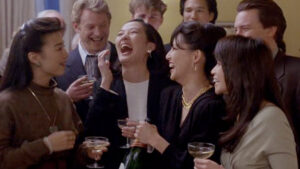
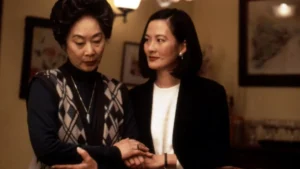
Finally, there’s An-Mei (Lisa Lu), whose mother cemented generational family wealth by taking her own life. Now, her daughter, Rose (Rosalind Chao), finds herself married to a lawyer (Andrew McCarthy). While she initially harbors a strong-will, she starts subjugating her own wants and needs in favor of her husband, something even he starts to note and dislike.
Tam and Bass’ story is a testament to interconnectedness, and the idea of what one is inadvertently passing down to the next generation. While explicitly and unapologetically centered in Chinese customs, there is a universality to The Joy Luck Club, for generational trauma is not exclusive to one locale or creed. While that term has become a buzzword in culture and in cinema, defining so many dramas and horror films over the course of two-decades-and-counting, Wang’s film fleshes the concept out with big emotional crescendos and heartbreaking vignettes.
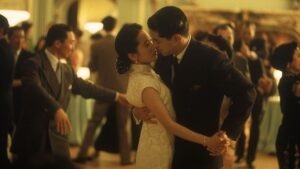
It can get exhausting on the basis of scope and a lack of nuance. However, Wang and company do a remarkable job at keeping this story linear despite a nonlinear structure. What do I mean by that? This is a film that features dozens of Asian-American actors. Some characters (most notably the moms) are played by three different individuals to represent their youth, teenage, and eventually elderly years. Factor in the subsequent generation of daughters, some of whom played by multiple individuals, their eventual spouses, and then supporting characters such as Wang regular Victor Wong as a hard-of-hearing piano teacher, and you have a massive ensemble in which both continuity and clarity could be lost.
Alas, that doesn’t happen, and The Joy Luck Club remains buoyant and engrossing, even as it approaches two-and-a-half-hours. One of the best analyses of the film, which I happened upon while browsing Letterboxd, is also one of the most pithy: here’s a film that reminds you that moms are girls. It’s such a ridiculous observation that it’s dead-on accurate. A “mom” is such an identity that it feels like a sex in itself. It’s the little revelations in the midst of drama executed on a grandiose scale that hit the hardest.
My review of Chan Is Missing
My review of Dim Sum: A Little Bit of Heart
My review of Slam Dance
My review of Eat a Bowl of Tea
My review of Life Is Cheap… But Toilet Paper Is Expensive
My review of Smoke (1995)
My review of Blue in the Face
My review of Chinese Box
Starring: Kieu Chinh, Tsai Chin, France Nuyen, Lisa Lu, Ming-Na Wen, Tamlyn Tomita, Lauren Tom, Rosalind Chao, Ying Wu, Irene Ng, Faye Yu, Emmy Yu, Yi Ding, Melanie Chang, Mai Vu, Michael Paul Chan, Andrew McCarthy, Christopher Rich, Russell Wong, Vivian Wu, and Victor Wong. Directed by: Wayne Wang.

About Steve Pulaski
Steve Pulaski has been reviewing movies since 2009 for a barrage of different outlets. He graduated North Central College in 2018 and currently works as an on-air radio personality. He also hosts a weekly movie podcast called "Sleepless with Steve," dedicated to film and the film industry, on his YouTube channel. In addition to writing, he's a die-hard Chicago Bears fan and has two cats, appropriately named Siskel and Ebert!