
Film reviews and more since 2009
Publication Date: 08-18-2026
The Texas Chain Saw Massacre (Texas Chainsaw Day 2026) review
Dir. Tobe Hooper
By: Steve Pulaski
Rating: ★★★
NOTE: Watched in theaters on August 18th in celebration of “Texas Chainsaw Day 2026.”
If you’re able to see The Texas Chain Saw Massacre on the big screen, you shouldn’t pass up the opportunity. If you’re able to see Tobe Hooper’s viciously brutal movie on the big screen on the day the movie takes place (August 18th), you’ll be treated to a unique experience you can use as clout with your fellow horror fans for years to come. Just me?
Paving the way for the slasher archetype alongside Alfred Hitchcock’s Psycho, Tobe Hooper’s grimy, lurid work of horror literally bleeds authenticity. Shot for five-to-six figures (depending on who you ask), the gritty film-stock only loans itself to a movie that appropriately feels humid with aesthetics that underscore the simple yet macabre nature of its premise.
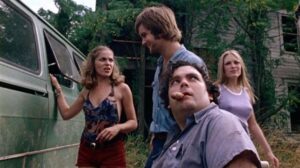
After a graverobber reportedly snatches corpses from a Muerto County cemetery, five teens take a road trip through the area in order to assure that one particular grave is still intact. That grave belongs to the grandfather of Sally (Marylin Burns) and her paraplegic brother Franklin (Paul A. Patain), and the two of them, along with a few other friends (Allen Danziger, William Vail, and Teri McMinn) pack a minibus bound for the graveyard — in more ways than one. En route, they pick up a homely hitchhiker (Edwin Neal), who seems amiable until he starts rambling about a slaughterhouse and takes a pocketknife to his own hand.
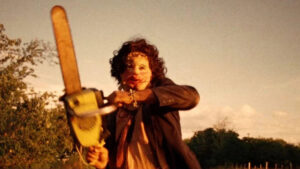
At their destination, they make the foolhardy decision to explore a home once owned by one of Sarah’s relatives. It’s there they encounter Leatherface (Gunnar Hansen), a chainsaw-wielding, Ed Gein-esque brute, and his family of cannibalistic murderers who intend to unleash a gruesome fury onto the five pals.
The Texas Chain Saw Massacre is remembered for its impact on the horror genre, as well as its false opening declaration that it’s based on true events. It’s not remembered for its characters, save for Franklin, who gets a bum rep despite the fact that he’s the only one of the five protagonists who dares adopt a personality. For all the love and attention “final girls” get these days, you seldom hear Sally Hardesty’s name mentioned along the likes of Sidney Prescott and Laurie Strode, and there’s a reason for that. Sally amounts to a lot of shrieking and reacting. The memorable final girls are more careful with their words and proactive.

Where Hooper and co-writer Kim Henkel’s script lacks in characterization, it makes up for with its dirty realism aesthetic. This is clearly an experimental, independent film, full of subversive camera angles (both high-and-low angle) and edited in a way that’s meant to be felt. Consider the first time we see Leatherface. He emerges from a room inside a home that’s accessible via a sliding door. Hooper’s camera is positioned at the front door; the door to Leatherface’s lair is deep in the background. Conventional cinematic wisdom would’ve instructed Hooper to bring the camera closer to the door of the lair. Instead, Hooper keeps our POV as if we’re standing on the porch of the home, like a voyeur or an unsuspecting neighbor. It is here where we are witnesses to a crime that went unsolved and unpunished.
Whenever I find myself talking about The Texas Chain Saw Massacre, I often use the word “grimy.” This is why.
The film’s unglamourous look extends to its sound. This is when Hooper’s film really comes alive. Bloodcurdling screams, shrieks of terror, most accompanied with gruesome torture, all of it feels lived-in because it’s not subjected to conventional processing. Marilyn Burns just had to suck down hot tea between takes. Maybe she just endured the worst sore throat possible, the kind where it feels like you’re swallowing glass with every gulp, to the point where tears roll down your cheeks. It was a noble sacrifice indeed.
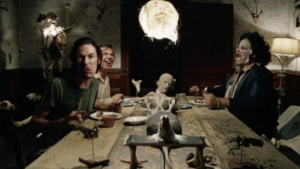
If you haven’t seen the film in years, or never at all, you might be surprised at how bloodless it ultimately is. Apparently, Hooper cut scenes in effort to obtain a PG rating (PG-13 didn’t exist in 1974, mind you). I don’t think any film with “chain saw,” let alone “massacre” in the title would pass by the MPAA without receiving an R-rating, but more egregious miscalculations have happened.
The climax of the film remains exceptional due to its rampant unpredictability, matched only by its ugliness. Having seen the film a couple times, I still found myself gripping the armrest of my seat, a credit again to the atmosphere and suspense Hooper and company cultivate. Tip of the cap to Ed Guinn, who plays the cattle truck driver, a character with no dialog but an impact deeply felt.
The Texas Chain Saw Massacre was a landmark, masterwork for the genre, unfit for any star rating, truly. I’ll compromise at three; for a film this unique, gratifying, and truly horrific, a star rating should be the least of anyone’s concern.
My review of Texas Chainsaw Massacre (2022)
Starring: Marilyn Burns, Paul A. Partain, Edwin Neal, Allen Danzinger, Jim Siedow, William Vail, Teri McMinn, and Gunnar Hansen. Directed by: Tobe Hooper.

About Steve Pulaski
Steve Pulaski has been reviewing movies since 2009 for a barrage of different outlets. He graduated North Central College in 2018 and currently works as an on-air radio personality. He also hosts a weekly movie podcast called "Sleepless with Steve," dedicated to film and the film industry, on his YouTube channel. In addition to writing, he's a die-hard Chicago Bears fan and has two cats, appropriately named Siskel and Ebert!