Film reviews and more since 2009
Publication Date: 02-27-2026
Smoke (1995) review
Dir. Wayne Wang
By: Steve Pulaski
Rating: ★★
After watching and writing about The Joy Luck Club, as I spend a portion of 2026 perusing the diverse and multidimensional filmography of director Wayne Wang, I was reading a very generic plot summary of his next film, Smoke, when I started to get flashbacks. A film said to be about the patrons of a cigar lounge took me back to college, where my best friend, Nick, and I would sometimes hit up downtown Elmhurst, IL. Nestled in the upscale district was a cigar shop, clunkily named “Lover Cigar.” In the window-front lounge, they had two posh leather couches and a flat-screen TV, which of course didn’t work.
I didn’t care. As a casual smoker in college, I insisted we go in there so I could chain a few Marlboro Smooths or smoke an ACID Blondie when I was feeling froggy. Props to Nick, an asthmatic nonsmoker, who sat far enough away from me so he could enjoy our company in a foreign albeit hazy setting. The shop was as dead as Michael Jackson no matter what day/time we arrived. In our multiple visits, we used to pick a random number and play the “over/under” game of how many would come into the shop; every time, the under “hit.” Unsurprisingly, it closed circa 2017, and the owner allowed us to take a framed photo of some poker-playing dogs that reminded us of our friend group.
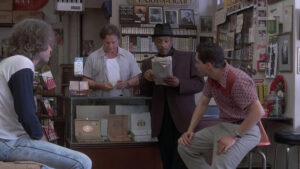
Even whilst watching Smoke, I was transported back to that cigar lounge, which functioned as a nice “third place” for me and my friend, even if we were the only two to inhabit it. There’s a great movie to be made with a cigar lounge as the central location, but it’s both saddening and frustrating to say that Wang’s film misses the mark and unfortunately goes up in smoke whenever Harvey Keitel isn’t on screen.
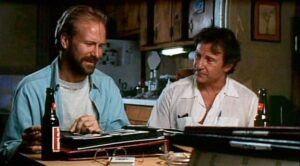
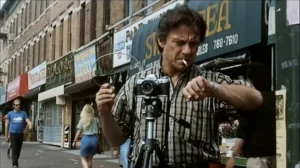
Keitel plays Auggie Wren, the owner of the Brooklyn Cigar Co. at the corner of Third Street and Eighth Avenue. His smoke-shop is the center of the world, as far as he’s concerned. Every morning at 8am, he stands across the street from it and takes a photograph, compiling all the snapshots into a binder he shows to Paul (William Hurt), a local customer and frequent customer. Paul is perplexed at why Auggie would take these seemingly generic photos day-after-day, year-after-year when “nothing much changes” and “they’re all the same.” Then he sees his late wife in one of the photos, and begins to cry. His wife, Ellen, was shot and killed sometime ago. Auggie recalls how if Ellen hadn’t given him exact change on that morning, or if she had stopped to so much as glimpse at anything when leaving the store, the fatal bullet would’ve missed her.
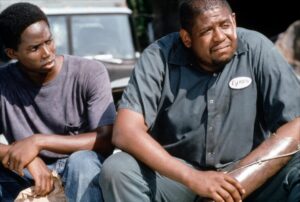
One morning, Paul is leaving Auggie’s shop when he is nearly struck by a truck barreling down the road. He is pulled out of danger by a young man named Rashid (Harold Perrineau Jr.). Clearly well-read and superstitious (or at least a little “stitious”), Paul insists he must repay Rashid, and buys him a lemonade. Over that beverage, Paul offers Rashid the privilege of shacking up in his apartment for a few days. In trouble with some goons over money, Rashid tracks down his father (Forest Whitaker), who runs a janky service station; made more impressive by the fact that one of his arms is artificial, with a metal grip for a hand.
Back to the cigar shop. One day, Auggie’s girlfriend (Stockard Channing), whom he hasn’t seen since Christ lost his sandals, walks into the store, borderline hysterical that (a) their daughter (?) is pregnant and (b) is addicted to drugs and living in a crack-den on the wrong side of town. Auggie fails to see how this is his problem, until his moral compass kicks in, and then all of a sudden he’s joining his ex on his way to save a woman he’s not even sure is his biological daughter.
Smoke plays like the more polished, mawkish version of Richard Linklater’s Slacker. That said, a story like this doesn’t need rounded corners and babyproofed edges. It needs grit and teeth, something it desperately lacks. When Keitel’s Auggie is on-screen, it crackles with wit and a laidback sense of working class confidence. That’s not surprising at all when you consider Keitel built a career playing characters who walk a fine line of being morally questionable yet enviably engrossing, often in the same scene.
Similar to the contemporary “Sean McVay effect” in the NFL, Quentin Tarantino got a lot of screenwriters opportunities after Miramax released Reservoir Dogs and later Pulp Fiction. Throw in Kevin Smith’s Clerks and you can see why a film like Smoke would make the cut over a year later, not to mention sharing the trait of having chapters. Miramax was a studio throwing any and every Tom, Dick, and Harry a check for their latest mediation on the happenstance of life and pure circumstance. Screenwriter Paul Auster found the right moment to shop his script.
That said, Smoke just didn’t grab me like it should’ve. As a comedy, it’s simply not that funny. As a drama, it’s simply not very interesting. Paul Auster’s script, coupled with Wang’s direction, results in jarring, hard cuts to different characters and settings that don’t feel as natural, and the narrative meat isn’t particularly strong enough for the viewer to forgive being jostled around as much as they are. Hurt’s Paul is too whiny and poetic to believe, while Perrineau Jr’s Rashid is so reserved it’s as if he repels connection. While Whitaker is afforded a meaningful monologue, his character mostly remains a functioning curiosity.
The film only sparkles with life and interest when Keitel’s Auggie, so lived-in and world-weary, is involved, but even his moving monologue at the end is slightly dampened by the fact that Keitel frequently shoots his eyes underneath the camera, presumably reading cue-cards that help him stay the course of what had to be a double-digit page wall of text. Wang’s proclivity for capturing lost souls stuck in their own freefall is on display, but after watching him so gracefully juggle multiple intergenerational stories in The Joy Luck Club, the harsh cuts and staccato narrative of Smoke feel like the work of an entirely different handler all together. Those elements, combined with an overreliance on sentimentality, make Smoke a fluttering that’s resonance dissipates far too quickly.
Starring: Harvey Keitel, William Hurt, Harold Perrineau Jr., Forest Whitaker, Ashley Judd, Jared Harris, and Giancarlo Esposito. Directed by: Wayne Wang.
My review of Chan Is Missing
My review of Dim Sum: A Little Bit of Heart
My review of Slam Dance
My review of Eat a Bowl of Tea
My review of Life Is Cheap… But Toilet Paper Is Expensive
My review of The Joy Luck Club
My review of Chinese Box

About Steve Pulaski
Steve Pulaski has been reviewing movies since 2009 for a barrage of different outlets. He graduated North Central College in 2018 and currently works as an on-air radio personality. He also hosts a weekly movie podcast called "Sleepless with Steve," dedicated to film and the film industry, on his YouTube channel. In addition to writing, he's a die-hard Chicago Bears fan and has two cats, appropriately named Siskel and Ebert!