Film reviews and more since 2009
Publication Date: 02-28-2026
Blue in the Face (1995) review
Dir. Wayne Wang and Paul Auster
By: Steve Pulaski
Rating: ★★½
Blue in the Face feels as if it’s been assembled of outtakes and deleted scenes from Wayne Wang’s film Smoke, released four months prior in June 1995. However, the film was apparently shot in a five-day span, and mostly involves a plethora of familiar faces, some of which not even in Smoke in any capacity, ad-libbing between takes and further building up the aura of the Brooklyn Cigar Co.
The cigar shop is still being run by Auggie Wren, again played by Harvey Keitel, only there’s less pressure on him this time around, for he is not the sole source of entertainment as he was in Smoke. Instead, Wang and co-director/co-writer recruited a shocking number of celebrities for this follow-up, in appearances that range from mere cameos to stars of their own aside. For example, the film opens with Mira Sorvino getting her purse snatched in front of the store. Auggie races to catch the young perp, hauls him back to the shop, and threatens to the call the police when Sorvino finds it in her heart to forgive the boy. Auggie won’t stand for moralizing even the youngest, pettiest thief in the neighborhood, and his response to the situation is so brazen it makes Sorvino scoff.

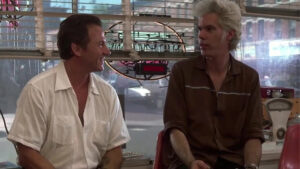
Time for the celeb roll-call: director Jim Jarmusch (Down by Law) plays a man who comes into Auggie’s shop to ceremoniously smoke his final Lucky Strike cigarette with the store proprietor himself before he quits cold turkey. The two men share a lovely dialog about the way smoking was popularized by Hollywood but is swiftly becoming taboo in the culture. Jarmusch ponders how exactly he’ll cap off sex with his partners if he will no longer smoke. Meanwhile, like Dante in Clerks, Auggie has a pair of girls fighting over him. One of whom is an emotionally volatile Mel Gorham; the other is Dottie (Roseanne Barr of all people), the frustrated wife of the cigar shop owner (Victor Argo).
Punctuating the film with a couple of direct-to-camera monologues — a Wang staple going back to his debut, Chan Is Missing — is Lou Reed. My favorite scene with Reed involves him reminiscing about how, as a young kid, he and his friends would light punks and pretend they were smoking, even though a punk’s very design makes it impossible to inhale the emitting smoke. “When that punk turned into a real cigarette,” Reed opines, “I don’t recall.” I remember imitating the same thing with a punk as a kid one Fourth of July. “Steven, get that fucking thing out of your mouth!,” my dad told me.
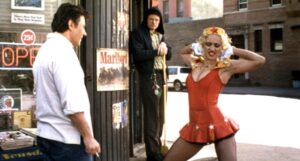
Michael J. Fox is a loiterer outside the store. Giancarlo Esposito is a regular customer. Madonna shows up in a scantily clad outfit to deliver Auggie a telegram accompanied with a dance. RuPaul shows up to lead Brooklyn Cigar Co. and passersby in a dance sequence at the end, to show how unserious this all is.
In a move that recalls the nonlinear structure of his experimental film Life is Cheap… But Toilet Paper is Expensive, Wang uses one of the subplots involving Argo’s desire to sell the shop and turn it into a health food store as a key to unlock the past. Auggie vehemently rejects his boss’ idea, not only because he’d be out of a job, but because the shop’s closure, he says, would be another nail in the coffin for the community of Brooklyn. Auggie’s statement prompts Argo to recall how the city felt when the Brooklyn Dodgers up-and-left for Los Angeles. In a dream, Argo comes face-to-face with Jackie Robinson, telling him how foolhardy his decision to sell his cigar shop would be.
If I’m all over the place, just know I’m doing Blue in the Face justice. It’s so loose and free-flowing, predicated on disjointed vignettes and the faintest hint of plot, that I actually liked it a touch more than Smoke. Smoke‘s problems stemmed from a lack of grit in its screenplay, resulting in gushy sentiment permeating the air like smoke from a Davidoff, and inert drama whenever Keitel’s Auggie would disappear for a while. Blue in the Face is almost singularly fixated on the cigar shop and the sidewalk outside, proving confinement was always the proper route to take for a story such as this. The further we got from Auggie’s, aka the center of the world, the further we got from the heart of the material.
Starring: Harvey Keitel, Mel Gorham, Giancarlo Esposito, Victor Argo, Jared Harris, Jim Jarmusch, Roseanne Barr, Lou Reed, Michael J. Fox, Madonna, RuPaul, and Mira Sorvino. Directed by: Wayne Wang and Paul Auster.
My review of Chan Is Missing
My review of Dim Sum: A Little Bit of Heart
My review of Slam Dance
My review of Eat a Bowl of Tea
My review of Life Is Cheap… But Toilet Paper Is Expensive
My review of The Joy Luck Club
My review of Chinese Box

About Steve Pulaski
Steve Pulaski has been reviewing movies since 2009 for a barrage of different outlets. He graduated North Central College in 2018 and currently works as an on-air radio personality. He also hosts a weekly movie podcast called "Sleepless with Steve," dedicated to film and the film industry, on his YouTube channel. In addition to writing, he's a die-hard Chicago Bears fan and has two cats, appropriately named Siskel and Ebert!