Film reviews and more since 2009
Publication Date: 08-27-2026
Teenage Sex and Death at Camp Miasma (2026) review
Dir. Jane Schoenbrun
By: Steve Pulaski
Rating: ★★★★
The opening of Teenage Sex and Death at Camp Miasma condenses the multi-decade timeline of a fictional slasher franchise into just a few riveting minutes. The story of Camp Miasma is told through movie posters, home video releases, toys, collectibles, newspaper articles that evolve into online publications, and more. A clear-as-day parody of Friday the 13th, the long-running 80s series spawned a litany of sequels, all featuring a villain known as “Little Death,” who was raised as both a boy and girl by their parents, and also dons what looks like a ceiling air conditioning vent on their head. Each sequel got tackier than the last, but the merch machine appeared to keep on rolling. Then the internet came along, social norms changed, and Camp Miasma got thinkpieced to a little death of its own.
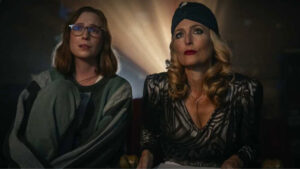
With the franchise in limbo, queer filmmaker Kris Williams (Hannah Einbinder) is hired to direct a reboot. She’s a huge fan of the series, but she knows she got the role so she could make nice the series’ concept, which has now been chided as being transphobic. She’s prepared to resurrect the “zombie IP” by tracking down the now-reclusive “final girl” from the original, a former actress named Billy Presley (Gillian Anderson of X-Files fame). In the film, Billy’s mostly quiet character is in the middle of having sex when she witnesses the Little Death inch their way closer to kill her and her lover.
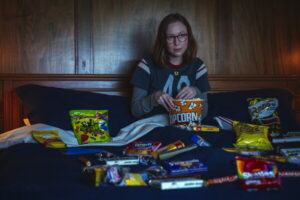
Billy now lives in isolation at Camp Trivoli, where the first film was shot. Kris believes Billy could be the lead in her reboot ala Jamie Lee Curtis in the most recent Halloween trilogy. On the first night of her visit, Billy treats Kris to fried chicken, weed, and copious junk food, with brightly colored bags of popcorn, Sweet Tarts, and popcorn — guilty pleasures, much like the Camp Miasma series is to the young, mousey filmmaker. For what it’s worth, fried chicken hasn’t been this erotically tinged since William Friedkin’s Killer Joe.
For most of its runtime, Teenage Sex and Death at Camp Miasma is a talky two-hander between a modern filmmaker concerned with messaging and a former actress more attracted to mood and tone. This is the third feature from Jane Schoenbrun, whose work has gotten better with each one. We’re All Going to the World’s Fair was a languid tone-poem for the young who no know life without internet. I Saw the TV Glow explored themes of gender identity, contrasting one who embraces it and one who doesn’t. Camp Miasma is more like the latter, with some overlapping themes, but more focus on how discovering things about one’s body in a sexual sense can be a lot like a bloody murder in a horror film. Consider the villain of the Camp Miasma franchise’s very name “Little Death,” which comes from “La petite mort,” and often used as a synonym for an orgasm.

Like Billy does to Kris, Schoenbrun arrests you with a story that’s as erotic as it is disturbing. Their script envelopes you in an atmosphere fear where your inhibitions are dulled but your awareness remains high, and that leads to some of the most entrancing sex and murder scenes in a year littered with great horror films. Where some films nail an idea, but skimp on the details — The End of Oak Street and Ready or Not 2: Here I Come to name a couple examples this year — here’s a film that, while packed with big ideas about sex, gender identity, and one’s relationship to (particularly graphic) media, carefully develops both protagonists as individuals. Schoenbrun’s incorporation of a film-within-a-film concept might loan itself to more questions, but does it in a way that loans itself to deeper themes as opposed to plotholes.
Einbinder turns in a terrific performance from her introduction. Anderson legitimately deserves an Oscar nomination. Where Einbinder plays intelligent yet indecisive in an accessible way as opposed to an aggravating one, Anderson’s performance is carnal, sensual, and arresting. She purrs her dialog with an entirely believable southern accent. The two of them are magical as a duo.
Equally playful is Schoenbrun’s sense of humor. Teenage Sex and Death at Camp Miasma is witty and often very funny. Supporting players such as Sarah Sherman and Louise Weard are listed as “Agent” and “Queer Assistant” on various devices, and Billy quieting Kris’ desire to label things as “transphobic” or “problematic” indicate that Schoenbrun themselves is a little exhausted by people trying to hold classic works to modern morality standards. The overarching motif here is the Kris’ lack of knowledge of who she is sexually too, further fueling confusion and misguidedness as a common thread.

As strong as Schoenbrun’s writing is, cinematographer Eric Yue’s heightened color palette and deployment of vibrant textures make this one of the best-looking movies of the year. When Little Death kills, a geyser of blood shoots out of their victims, with the entire film — even beyond the extended sequence where we watch a solid portion of Camp Miasma — looks like an 80s slasher film in all of its analog glory. It’s not imitation, it’s a full-throated, gorgeous recreation.
Apparently, one of the sources of inspiration for Teenage Sex and Death at Camp Miasma was Schoenbrun being offered a wealth of unproduced scripts, including one of a Leprechaun reboot. Credit is due to them pursuing another original work and additional credit to Mubi, taking a $10 million chance on a wacky original that was never going to bring box office gold, but I predict will enjoy a wonderful life on streaming. Nobody can nor should fault Inde Navarrette of Obsession for taking the role of Rogue in the next X-Men reboot, but we can still mourn that another role as interesting as Nikki isn’t likely on the horizon for a period of time. Rapper Meek Mill once said, “let your next work be your best work.” Schoenbrun has taken that and Forrest Gumped with it.
My review of We’re All Going to the World’s Fair
My review of I Saw the TV Glow
Starring: Hannah Einbinder, Gillian Anderson, Jack Haven, Patrick Fischler, Sarah Sherman, Jasmin Savoy Brown, Arthur Conti, and Louise Weard. Directed by: Jane Schoenbrun.

About Steve Pulaski
Steve Pulaski has been reviewing movies since 2009 for a barrage of different outlets. He graduated North Central College in 2018 and currently works as an on-air radio personality. He also hosts a weekly movie podcast called "Sleepless with Steve," dedicated to film and the film industry, on his YouTube channel. In addition to writing, he's a die-hard Chicago Bears fan and has two cats, appropriately named Siskel and Ebert!