
Film reviews and more since 2009
Publication Date: 12-24-2025
Jumanji (1995) review
Dir. Joe Johnston
By: Steve Pulaski
Rating: ★★½
Growing up, every kid I knew and hung out with, boy or girl, seemed to have three VHS tapes in their home: Honey, I Shrunk the Kids, Flubber, and Jumanji. Toy Story and The Lion King could’ve very well been there amongst other clam-shell VHS cases, but my eyes might’ve averted those generic-looking tape-cases compared to the absurd artworks of the ones I just mentioned. Being that most of my friends were born before or the year of these films’ releases, I always wondered how they came to know about them. Until today, I never watched Jumanji nor had much interest in it; of all the Robin Williams films, like Flubber, it looked the least interesting to me. I was too captivated by One Hour Photo on Cinemax when I was around eight-years-old.
Watching Jumanji with this footnote in mind, with cautious anticipation for the $180 million (!) sequel that will be released in a few weeks, the undeniable realization of what a nostalgic touchstone this film is for many came over me. This is the kind of films kids watch out of nowhere one day and then request their parents to rewind it again and again until they’ve either worn out the tape or parents put the kibosh on the fun — which ever inevitability occurs first. It’s exactly that kind of high-octane, family-friendly adventure film that captivates young children and gives adults a little fun for their money, as well, even if in contemporary context, the effects and jokes have aged and the film’s sense of grows repetitious as it undermines its own curiosity factor. It’s relatively easy to appreciate a film like this, even in a small way, because it’s exactly the kind of film Hollywood is too scared to make anymore.
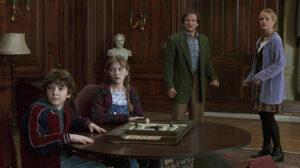
The plot (in case you’re one of the ten people under the age of 30, like me, who has yet to see the film): a century after two young kids bury a treasure chest with a mysterious item inside, a young boy named Alan Parrish (Adam Hann-Byrd) stumbles upon it. It’s a board-game known as “Jumanji,” and after being beaten by a gang of bullies and scoffed at by his father, a shoe factory mogul, Alan has his friend Sarah (Laura Bell Bundy) over to experiment with it. The board winds up taking on a life of its own, spitting out rhyming phrases, which serve as warnings revealed upon the roll of two dice. When Alan rolls a wrong combination, the molecules of his body turn into grains of sand to be sucked into the board, leaving Sarah running for protection and a town presuming that Alan was brutally killed by his father.
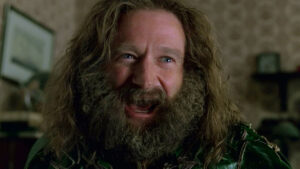
26 years later, the house is occupied by Judy and Peter Shepherd (Kirsten Dunst and Bradley Pierce), two children similar in age to the aforementioned tweens. Living with their aunt, they occupy themselves with Jumanji while exploring the attic of their home one day, summoning a swarm of monkeys and a lion before inadvertently releasing a now bearded, adult Alan (Robin Williams) from the confines of the game. Alan is hysterical having spent nearly three decades in the jungle, but the three now have a big challenge in trying to suppress the uncontrollable tendencies of this board-game by playing it. This includes getting back in touch with an adult Sarah (Bonnie Hunt), whose turn it is after Alan’s return.
One supporting performer comes in the form of David Alan Grier as a bumbling police-officer, who is one of the first people in the outside world to witness Alan upon his return. He also has a connection with Alan’s father in the form of being a factory worker at his main shoe-shop before being fired due to Alan’s own error. Another recurring role is John Hardin Van Pelt’s, who plays a hunter that comes back with Alan in an attempt to exterminate him after his abrupt exit from the jungle of the board-game. In the meantime, Judy and Peter try to muster up their own courage and wits in order to outsmart the game they’ve restarted.
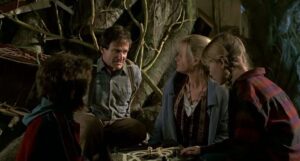
You don’t have to look too deeply in Jumanji for indications that the film has become dated, for the most glaring element is the specials effects. Directed by Joe Johnston, the same soul who made Jurassic Park III possible, and the first Captain America film many years later, the effects carry that clumsily rendered, mid-nineties CGI that impressed at the time but went on to grow more putrid with every passing year. The ugly animatronics on the many jungle creatures, particularly the monkeys, look awful and distract from the camaraderie on screen, which you’ll see winds up being more engaging when it’s entirely centered on the human characters. During that time, if only for a moment, the special effects are of no distraction and the natural world can react to the chaos (IE: the department store scene, which ranks up there with The Blues Brothers and I Saw Mommy Kissing Santa Claus for best scenes of store-destruction). This is obviously a complaint that comes with hindsight and the factor of time, but even if you’re willing to draw comparison to Joe Dante’s Gremlins, one of the films that feels like the inspiration for this one (as well as Tremors given how the Venus flytrap creature operates), the effects have stood the test of time and the artists were using technology with significantly limited graphical capabilities.
Then there are the riddles, which pop up in the center of the game-board in a circular green-vortex that looks like the underside of a magic 8 ball. The riddles are the kind of witty, ominous little clues that inspire memories of even the cheesiest Goosebumps stories, but the second they appear long enough to recited by the children, the prophesied quotes begin revealing their ambiguous meanings. If audiences, and the characters, for that matter, were given just a tiny bit of time to digest what was just revealed to them, this film would transcend one that happened unto the audience into one where the audience felt like an active participant in the events on screen. This could very well constitute as a nitpick, but by the third act, which is still mostly well-handled, the riddles have become perfunctory and just about irrelevant given the fact that we’ll see what happens no sooner than the last, rhyming word is uttered from the mouth of Judy or Peter. There’s not even a moment of suspense present as the film comes on and continues to rely on these riddles.
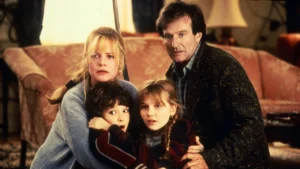
Jumanji is largely anchored by another charismatic and physical performance by Robin Williams, who can be likable even when he isn’t, and for that matter, the rest of the cast, who do a splendid job of bringing the film to life (even if Hunt’s adult Sarah is a bit cloying in how frantic she initially is upon reconnecting with Alan). One of the pleasant aspects at hand is no one feels at the mercy of the special effects; they feel like they’re on an equitable playing field even when they’re breathlessly running from danger. Furthermore, the film never feels too manic for its own good despite being somewhat messily paced. This also goes on to assure that these characters are never dueling with a mess of special effects and a crummy narrative that looks at them as pawns rather than people.
Your enjoyment of Jumanji will vary depending on your level of connection to it as a film. Was it something you watched as a child? Was it something that you recall being one of your first experiences in theaters? Can you still locate the VHS tape in your home? If you’ve answered “yes” to any of the above questions, I will have just made myself out to be a joyless cynic in your eyes, and just like your presumed appreciation and love for Jumanji, I can live with that and move forward happily.
My review of Jumanji: Welcome to the Jungle
Starring: Robin Williams, Kirsten Dunst, Bradley Pierce, Bonnie Hunt, David Alan Grier, Adam Hann-Byrd, Laura Bell Bundy, and John Hardin Van Pelt. Directed by: Joe Johnston.

About Steve Pulaski
Steve Pulaski has been reviewing movies since 2009 for a barrage of different outlets. He graduated North Central College in 2018 and currently works as an on-air radio personality. He also hosts a weekly movie podcast called "Sleepless with Steve," dedicated to film and the film industry, on his YouTube channel. In addition to writing, he's a die-hard Chicago Bears fan and has two cats, appropriately named Siskel and Ebert!